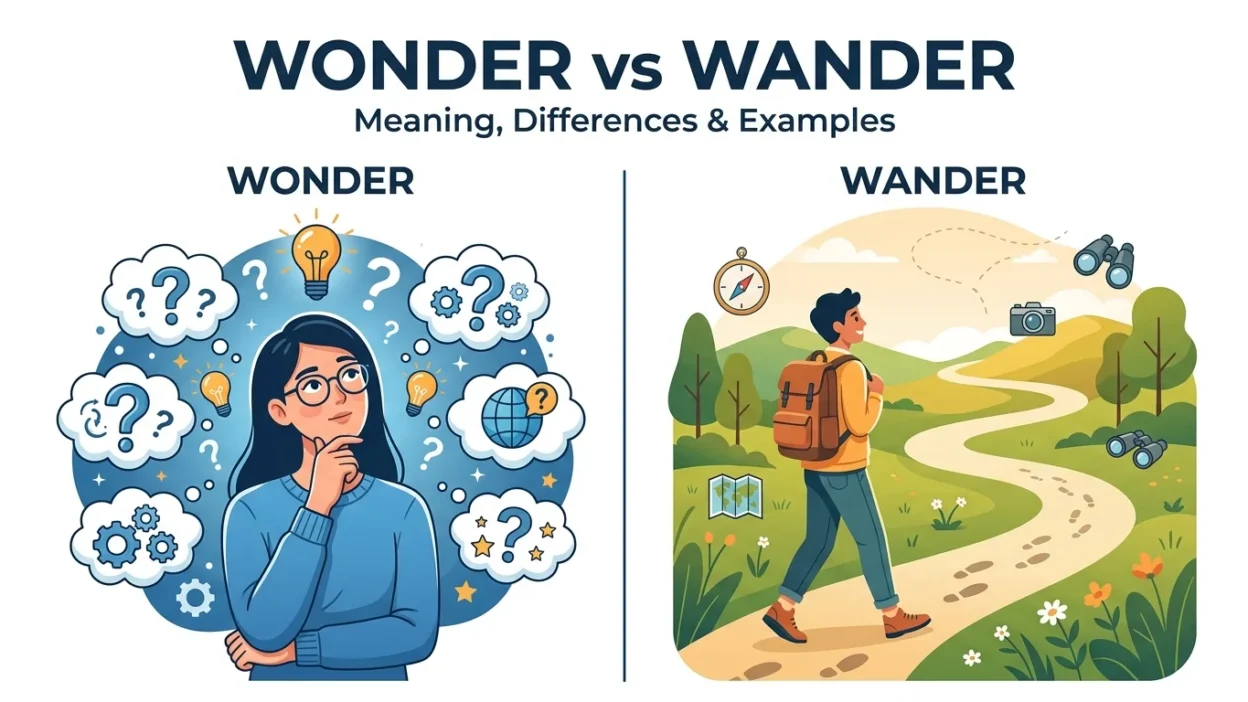
Wonder and wander are two English words that look and sound remarkably similar, but they describe completely different ideas. This makes them a common source of confusion for English learners and even native speakers when writing quickly. Wonder usually relates to curiosity, amazement, or a desire to know something, while wander means to move around without a clear destination or direction. For example, you might wonder why someone is late, but you might wander around a new city while waiting for them.
Understanding the difference between wonder vs wander is useful because both words can appear frequently in everyday conversation, academic writing, stories, and online communication. Their pronunciation is also similar enough to cause mistakes, especially when listening rather than reading. Once you connect each word with its core meaning, however, the distinction becomes simple. In this guide, you’ll learn how to use wonder and wander correctly, see practical examples, avoid common mistakes, and remember the difference easily.
Quick Answer
Wonder means to think about something with curiosity or amazement. Wander means to move around without a fixed destination or direction. If your mind is curious, you wonder. If your feet are moving without a plan, you wander.
Why People Confuse It
The main reason people confuse wonder and wander is their similar spelling and pronunciation.
Both words contain the familiar -nder ending, and their first vowel sounds can be difficult to distinguish in fast speech. In some accents, they may sound especially close.
There is also another reason: both words can describe an experience that is not completely planned.
- You wonder about something when you are unsure or curious.
- You wander somewhere when you move without a specific destination.
The easiest way to separate them is to focus on the action:
Wonder = thinking.
Wander = moving.
This simple distinction works in most everyday situations.
First Word: Wonder
Wonder can function as both a verb and a noun.
As a verb, wonder means to think about something because you are curious, uncertain, or interested.
Examples
- I wonder where Sarah went.
- He wondered why the meeting was canceled.
- I wonder if they will arrive on time.
- She often wonders about the future.
The word can also express amazement or admiration.
- We wondered at the beauty of the mountains.
- The children looked at the fireworks in wonder.
As a noun, wonder can mean a feeling of surprise and admiration.
- The child stared at the enormous waterfall in wonder.
- The ancient building is considered a modern wonder.
Common expressions with “wonder”
You will often see wonder in these structures:
- I wonder if…
- I wonder why…
- I wonder whether…
- No wonder…
- It’s a wonder that…
- in wonder
For example:
I wonder if James has finished his work.
Here, wonder means “I am curious to know.”
Second Word: Wander
Wander is primarily a verb meaning to move around without a particular destination, purpose, or direction.
Examples
- We wandered through the old town.
- The child wandered away from the group.
- I like to wander around the market.
- His mind began to wander during the lecture.
It can describe physical movement:
We wandered around the park for an hour.
It can also describe thoughts or attention moving away from the subject:
My mind started to wander during the long presentation.
So, wander does not always involve walking. You can also have a wandering mind, wandering thoughts, or even a conversation that wanders from the main topic.
Common expressions with “wander”
- wander around
- wander off
- wander away
- wander through
- wander into
- wander aimlessly
- mind wanders
For example:
We wandered through the streets without using a map.
The emphasis is on movement without a specific route or destination.
Comparison Table
| Feature | Wonder | Wander |
| Main meaning | To think with curiosity or amazement | To move without a fixed direction |
| Main idea | Thinking | Moving |
| Part of speech | Verb and noun | Mainly a verb |
| Example | I wonder what happened. | We wandered around town. |
| Common phrase | I wonder if… | Wander around |
| Related idea | Curiosity, amazement | Exploring, drifting |
| Memory clue | Mind | Movement |
When to Use Each
Use wonder when you are talking about curiosity, uncertainty, questioning, or amazement.
Use “wonder” when:
- You want to know something.
- You are curious about an answer.
- You are thinking about a possibility.
- You feel amazed by something.
Example:
I wonder whether Mike will join us.
Use wander when you are talking about moving without a definite destination or direction.
Use “wander” when:
- You walk around without a plan.
- Someone moves away from a group.
- You explore casually.
- Your thoughts or attention drift.
Example:
We wandered around the city until sunset.
A useful test is to ask:
Is this about curiosity or movement?
- Curiosity → wonder
- Movement → wander
Examples
Here are practical examples showing the difference clearly.
- I wonder what time the train arrives.
→ I am curious about the answer. - We wandered around the village all afternoon.
→ We walked around without a specific route. - She wondered why he didn’t call.
→ She wanted to know why. - The tourists wandered through the narrow streets.
→ They explored by walking around. - I wonder if this is the right decision.
→ I am uncertain and thinking about it. - My dog wandered into the neighbor’s garden.
→ The dog moved there without a planned destination. - He looked at the painting in wonder.
→ He felt amazement. - My mind tends to wander during long meetings.
→ My attention drifts away. - I wonder how she learned to speak French so well.
→ I am curious about it. - We wandered along the beach before dinner.
→ We walked casually without a fixed destination. - No wonder you’re tired after working all night.
→ Your tiredness is understandable. - The conversation wandered from business to travel.
→ The conversation gradually moved away from its original topic. - I wonder whether they know the truth.
→ I am curious about their knowledge. - The lost hiker wandered through the forest.
→ The hiker moved without a clear route.
Common Mistakes
Mistake 1: Using “wander” for curiosity
❌ I wander why she left early.
✅ I wonder why she left early.
When you mean “I am curious,” always use wonder.
Mistake 2: Using “wonder” for walking
❌ We wondered around the city.
✅ We wandered around the city.
When someone moves around without a fixed destination, use wandered.
Mistake 3: Confusing “I wonder” with a physical action
The phrase I wonder… is extremely common in English.
I wonder where my keys are.
This does not mean that you are walking around looking for your keys. It means you are thinking about where they might be.
Mistake 4: Misspelling “wander”
Because wonder is more familiar to many learners, people sometimes write wonder when they actually mean wander.
Compare:
- We wandered around the museum. → movement
- We wondered about the museum’s history. → curiosity
Memory Trick
Here is an easy way to remember wonder vs wander:
Wonder = “Why?”
If you are asking yourself why, what, where, when, or how, you probably wonder.
I wonder why he is late.
Wander = “Walk”
Think of the a in wander as standing for away.
Wander = walk away or around without a plan.
Another quick memory trick is:
Wonder → mind
Wander → feet
Your mind wonders about questions.
Your feet wander around places.
This distinction is simple enough to remember even when you are writing quickly.
American vs British English
There is no major difference in meaning between American and British English for wonder and wander. Both varieties use the words in essentially the same ways.
The more noticeable difference may come from pronunciation, because accents can change how the vowels in these words sound.
For example:
- wonder is commonly pronounced /ˈwʌn.dər/
- wander is commonly pronounced /ˈwɒn.dər/ in many British pronunciations and /ˈwɑːn.dər/ in many American pronunciations
Pronunciation can vary by regional accent, so spelling and context are often more reliable than sound alone.
The meanings remain consistent:
I wonder what happened.
means the same thing in American and British English.
We wandered around London.
also has the same basic meaning in both varieties.
Similar Words
Learning related words can make the distinction even clearer.
Words similar to “wonder”
Depending on the context, alternatives include:
- think
- question
- ask oneself
- be curious
- marvel
- admire
Example:
I wonder what happened.
Similar idea:
I am curious about what happened.
Words similar to “wander”
Depending on the context, alternatives include:
- roam
- stroll
- drift
- meander
- roam around
- walk aimlessly
- explore
Example:
We wandered around the city.
Similar idea:
We strolled around the city.
Be careful, though: these words are not always perfect substitutes. Wander can describe both physical movement and drifting thoughts, while wonder is mainly connected with curiosity or amazement.
Frequently Asked Questions
Is it “I wonder” or “I wander”?
It is “I wonder” when you mean “I am curious” or “I want to know.”
Example:
I wonder where she lives.
Is it “wander around” or “wonder around”?
The correct phrase for moving around without a particular destination is “wander around.”
Example:
We wandered around the shopping district.
What is the easiest way to remember wonder vs wander?
Remember wonder = mind and wander = movement. If you are thinking or feeling curious, use wonder. If you are walking or drifting without direction, use wander.
Can “wander” describe thoughts?
Yes. Wander can describe thoughts, attention, or the mind drifting away from the subject.
Example:
My mind wandered during the lecture.
Can “wonder” be a noun?
Yes. Wonder can be a noun meaning a feeling of amazement or something remarkable.
Example:
She gazed at the stars in wonder.
Are “wonder” and “wander” pronounced the same?
No. They are similar in pronunciation, but they are different words with different vowel sounds. The exact pronunciation can vary by accent.
Is “wander” always about walking?
No. It can describe physical movement, but it can also describe thoughts, attention, conversations, or other things that drift away from a fixed direction.
Final Verdict
The difference between wonder and wander becomes easy once you focus on their central ideas. Wonder is connected to the mind: you wonder when you are curious, uncertain, or amazed. Wander is connected to movement: you wander when you move around without a clear destination or when something drifts away from its original direction.
So, when you are unsure which word to choose, ask yourself what is happening. If you are thinking “I wonder why…”, choose wonder. If you are walking around without a particular plan, choose wander. With this simple distinction, you can avoid one of the most common English word choice mistakes.
Remember This
Wonder = curiosity or amazement.
Wander = movement without a fixed direction.
Your mind wonders; your feet wander.
That one sentence is usually enough to keep these two easily confused words straight.
Conclusion
Although wonder and wander look and sound similar, their meanings are quite different. Wonder is about curiosity, questioning, or amazement, while wander describes aimless or casual movement. Both words can also be used figuratively, such as when your mind wanders or when a conversation wanders away from its original subject.
The next time you hesitate between these words, remember the simplest rule: wonder is about what your mind wants to know, while wander is about where something moves. Practice the examples above, especially common phrases like “I wonder if…” and “wander around,” and the difference will quickly become natural in both speaking and writing.

Hadley Price creates heartfelt contemporary fiction exploring relationships, hope, resilience, and personal growth. Her emotionally rich storytelling connects with readers through memorable characters and inspiring life experiences worldwide.