
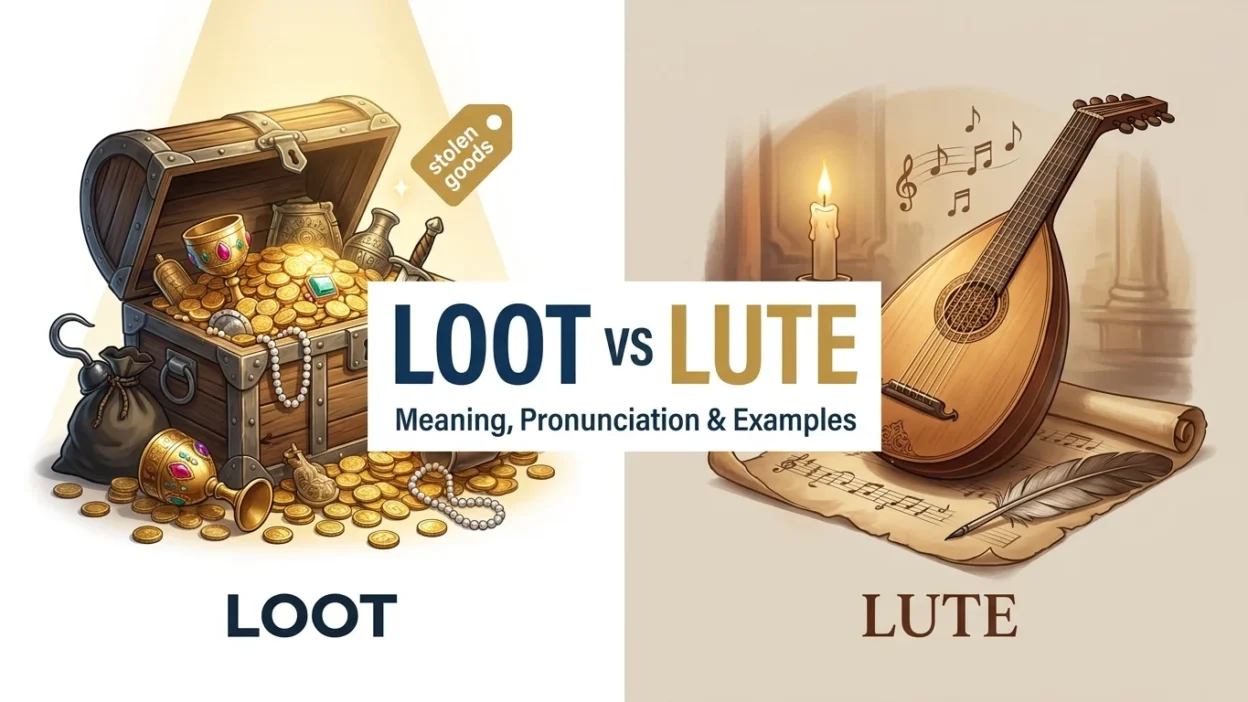
English has many words that look or sound similar but have completely different meanings. “Loot” and “lute” are a good example. They differ by only one letter, yet they refer to entirely different things. If you are unsure whether to write loot or lute, understanding their meanings and pronunciation will help you choose the correct word every time.
Loot is connected with stolen or valuable goods, especially things taken during a robbery, war, or other unlawful activity. Lute, on the other hand, is the name of a traditional stringed musical instrument with a rounded body and a neck. Although these words are spelled differently, their pronunciation is also slightly different. In this guide, we’ll explain loot vs lute, including their definitions, pronunciation, grammatical uses, common mistakes, examples, and a simple memory trick. By the end, you’ll know exactly when to use each word.
Quick Answer
Loot means valuable goods taken, often illegally, or the act of taking such goods. Lute is a traditional stringed musical instrument. Remember: loot relates to stolen treasure, while lute relates to music.
Why People Confuse It
People often confuse loot and lute because they are visually similar and both contain the letters l and t. For learners of English, changing just one vowel can make these words easy to mix up.
The meanings, however, are completely unrelated:
- Loot → stolen or valuable goods; to steal goods.
- Lute → a traditional stringed musical instrument.
- Loot is commonly used in discussions about theft, war, robbery, games, and valuable items.
- Lute is mainly used when discussing music, musical history, or traditional instruments.
Pronunciation can also cause confusion, particularly for English learners who are still developing their vowel sounds.
First Word: Loot
Loot can be a noun or a verb.
Loot as a noun
As a noun, loot means valuable goods or possessions that have been stolen or taken, particularly during a robbery, conflict, or period of disorder.
Examples:
- The thieves escaped with a large amount of loot.
- Soldiers were accused of taking loot from the town.
- Police recovered the stolen loot.
The word can also be used more casually for valuable rewards or items collected in certain games.
Loot as a verb
As a verb, loot means to steal valuable goods, usually from a place during a period of disorder or conflict.
Examples:
- The attackers looted several shops.
- The museum was looted during the conflict.
- Rioters looted stores in the area.
Common forms include:
- Present: loot
- Past: looted
- Present participle: looting
Second Word: Lute
Lute is a noun referring to a traditional stringed musical instrument.
A lute generally has a rounded or pear shaped body, a neck, strings, and a sound hole. It was especially important in European music during the Renaissance and earlier periods.
Examples:
- The musician played a beautiful melody on the lute.
- The museum has an ancient lute on display.
- Renaissance composers often wrote music for the lute.
The word is strongly associated with music, historical instruments, Renaissance music, and classical traditions.
Lute pronunciation
Lute is pronounced like “loot” in standard English:
lute → /luːt/
This is an important point: although loot and lute have different spellings and meanings, they are generally homophones in modern English.
Comparison Table
| Word | Part of Speech | Meaning | Pronunciation | Example |
| Loot | Noun/Verb | Stolen goods or to steal goods | /luːt/ | The thieves divided the loot. |
| Lute | Noun | A traditional stringed instrument | /luːt/ | She learned to play the lute. |
The key difference is meaning and spelling, not pronunciation.
When to Use Each
Use loot when you are talking about:
- Stolen property
- Valuable goods taken unlawfully
- Robbery
- Looting during conflict or unrest
- Rewards or valuable items in video games
- The act of stealing goods
Example:
The police found the stolen loot in an abandoned building.
Use lute when you are talking about:
- A musical instrument
- String instruments
- Renaissance music
- Medieval or early music
- Historical musical performances
Example:
The musician performed the Renaissance piece on a lute.
A simple rule
If it involves stealing, choose “loot.”
If it involves music, choose “lute.”
Examples (10+)
Here are clear examples showing the difference between loot and lute:
- The robbers divided the loot among themselves.
- Police recovered the stolen loot from the house.
- The rebels were accused of looting local businesses.
- The video game rewards players with valuable loot.
- The thieves escaped with their loot before police arrived.
- He bought an antique lute from a specialist.
- The musician played the lute beautifully.
- The museum displays a sixteenth century lute.
- She is studying the history of the lute.
- The composer wrote several pieces for the lute.
- The soldiers were accused of taking loot from the village.
- The performer carefully tuned his lute before the concert.
- The game offers rare loot after defeating powerful enemies.
- Historians have discovered illustrations of people playing the lute.
Notice how the surrounding context makes the intended word clear.
Common Mistakes
1. Using “lute” when you mean stolen goods
Incorrect:
The robbers divided the lute.
Correct:
The robbers divided the loot.
The sentence is about stolen property, so loot is correct.
2. Using “loot” for a musical instrument
Incorrect:
He played the loot at the concert.
Correct:
He played the lute at the concert.
The instrument is spelled lute.
3. Assuming different spelling means different pronunciation
Although the spelling differs, loot and lute are normally pronounced identically.
This makes them a particularly interesting example of homophones.
4. Forgetting that “loot” can be a verb
Some learners only recognize loot as a noun.
But it can also function as a verb:
The criminals looted the store.
Memory Trick
Here’s an easy way to remember the difference:
Loot = Looted goods
Lute = Listening to music
Think:
Loot is stolen. Lute is musical.
Another trick is to associate the “u” in lute with “music” both point you toward the musical meaning.
If you see words such as robbery, thieves, stolen, valuables, or stealing, choose loot.
If you see words such as music, strings, musician, Renaissance, or instrument, choose lute.
American vs British English
There is essentially no major difference in meaning between American and British English for these two words.
In both varieties:
- Loot means stolen goods or the act of stealing goods.
- Lute refers to the traditional stringed instrument.
- Both are generally pronounced /luːt/.
The word loot is also widely used in modern informal contexts, particularly in gaming. For example, gamers may talk about collecting loot after defeating an opponent.
The word lute remains more specialized because it refers to a particular historical musical instrument.
Similar Words
Understanding related words can make the distinction easier.
Words related to “loot”
- Steal — take something without permission
- Stolen goods — property obtained through theft
- Plunder — valuable things taken by force
- Robbery — stealing from a person or place
- Looting — stealing goods, especially during disorder
Words related to “lute”
- Instrument — a device used to produce music
- Guitar — a modern stringed instrument
- Ukulele — a small stringed instrument
- Mandolin — a plucked string instrument
- Harpsichord — a historical keyboard instrument often associated with early music
Although some of these instruments are related historically or musically, they are not interchangeable with lute.
Frequently Asked Questions
Is “loot” and “lute” the same word?
No. Loot means stolen or valuable goods, or the act of stealing them. Lute is a traditional stringed musical instrument.
Are loot and lute pronounced the same?
Yes. In standard English, both are generally pronounced /luːt/, making them homophones.
What does loot mean?
Loot means valuable goods taken unlawfully, especially during robbery, war, or unrest. As a verb, it means to steal such goods.
What does lute mean?
A lute is a traditional stringed musical instrument with a rounded body and a neck.
Is loot a noun or a verb?
It can be both. For example, “The thieves took the loot” uses it as a noun, while “They looted the store” uses it as a verb.
Is lute still used today?
Yes. Although it is strongly associated with historical and Renaissance music, musicians still play the lute today.
What is an easy way to remember loot vs lute?
Remember: Loot is stolen; lute is musical. If you’re talking about theft, use loot. If you’re talking about an instrument, use lute.
Final Verdict
The difference between loot and lute is simple once you focus on meaning. Loot refers to stolen or valuable goods and can also mean the act of stealing them. Lute refers to a traditional stringed musical instrument.
Interestingly, these two words are generally pronounced the same, so spelling and context are essential. When writing, ask yourself whether the sentence is about stolen valuables or music. That quick check will almost always give you the right answer.
Remember This
Loot = stolen goods or stealing
Lute = a musical instrument
Same sound, different spelling, completely different meaning.
Conclusion
Knowing the difference between loot vs lute is a small but useful step toward more accurate English writing. Even though both words are normally pronounced the same, their meanings could hardly be more different. Loot belongs to the vocabulary of theft and valuable possessions, while lute belongs to the world of music and historical instruments.
The easiest approach is to rely on context. If you’re discussing robbers, stolen property, or game rewards, use loot. If you’re discussing a musician, strings, or Renaissance music, use lute. Remember the simple rule loot is stolen, lute is musical and you’ll never have to second guess this word pair again.

Nova Turner specializes in imaginative science fiction blending futuristic technology, thrilling adventures, and powerful human emotions. Her innovative storytelling inspires curiosity, creativity, and exploration among readers of every age.