If you have ever written “contious” and wondered whether it is a shortened form of “continuous,” you are not alone. This is a common spelling mistake because the word continuous contains several vowels and can be difficult to spell correctly at first glance. The confusion becomes even more likely because English pronunciation does not always make every letter obvious. However, when you need the correct spelling in an essay, email, report, website, or professional document, there is a clear answer: continuous is the correct English word, while contious is a misspelling.
Understanding the difference is useful because continuous has an important meaning in everyday and academic English. It describes something that happens without stopping or continues over a period of time. You may use it to describe continuous rain, continuous improvement, continuous noise, or a continuous process. In this guide, we will examine continuous vs contious, explain why the mistake happens, provide practical examples, and give you an easy memory trick for remembering the correct spelling.
Quick Answer
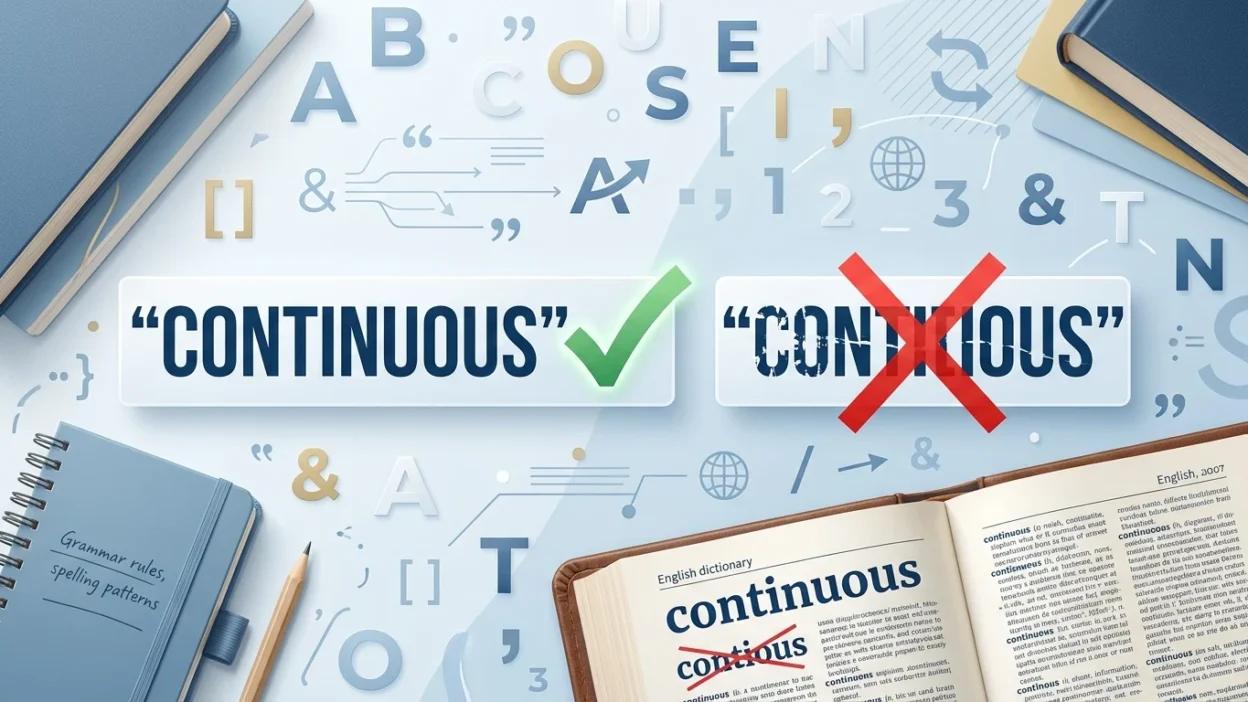
Continuous is the correct spelling. Contious is incorrect and should not be used in standard English. Continuous means happening without interruption or continuing over time. For example: “The machine requires continuous monitoring.”
Why People Confuse It
The main reason people confuse continuous and contious is spelling.
When speaking, the middle sounds of continuous can blend together. This can make the word seem as though it contains fewer letters than it actually does.
There is also a visual temptation to write contious, especially if you are spelling the word from memory.
Remember that the correct spelling contains:
con + tin + u + ous = continuous
The important middle section is “tin” and the word ends in “-uous.”
Common reasons for the mistake
- Writing the word according to how it sounds
- Forgetting the “tin” after “con”
- Dropping one of the vowels
- Typing quickly
- Assuming contious is an accepted shortened spelling
The good news is that contious is not a standard alternative spelling. If you see it in formal writing, it should normally be corrected to continuous.
First Word: Continuous
Continuous is the correct word.
It is an adjective meaning continuing without stopping or without interruption.
Definition
Continuous = continuing for a period of time without stopping or being interrupted.
For example:
- We experienced continuous rain throughout the afternoon.
- The company focuses on continuous improvement.
- The patient requires continuous monitoring.
- There was a continuous flow of water.
The word can describe physical events, processes, sounds, activities, or abstract ideas.
Continuous in a sentence
Correct:
“The continuous noise made it difficult to concentrate.”
Here, continuous tells us that the noise continued without stopping.
Related forms
You may also encounter:
- Continuously — adverb
- Continuity — noun
- Continue — verb
- Continual — adjective with a slightly different meaning
For example:
“The system operates continuously.”
Second Word: Contious
Contious is incorrect.
It is a misspelling of continuous and does not function as a standard English word.
Incorrect example
❌ “The machine needs contious maintenance.”
Correct example
✅ “The machine needs continuous maintenance.”
If you are writing an academic paper, business email, resume, report, or other formal text, always use continuous.
Why “contious” looks believable
English contains many words in which letters are not pronounced exactly as learners expect. As a result, people sometimes remove letters they do not clearly hear.
That can turn:
continuous → contious
But pronunciation should not be used as the only guide for spelling this word.
Comparison Table
| Word | Correct? | Meaning | Example |
| continuous | ✅ Yes | Continuing without stopping | We had continuous rainfall. |
| contious | ❌ No | Misspelling of continuous | Avoid this spelling. |
The key point is simple: use continuous; avoid contious.
When to Use Each
There is actually only one standard spelling to use in normal English.
Use “continuous”
Use continuous when describing something that:
- continues without interruption
- does not stop
- remains ongoing
- occurs in an uninterrupted sequence
- operates steadily over a period of time
Examples include:
Continuous service
A service that operates without interruption.
Continuous improvement
An ongoing effort to improve something.
Continuous monitoring
Monitoring that occurs constantly or without interruption.
Continuous rainfall
Rain that keeps falling without a meaningful break.
Do not use “contious”
There is no standard situation in which contious should replace continuous.
If you are unsure, choose continuous.
Examples
- The continuous rain caused flooding in several areas.
- The doctor recommended continuous monitoring.
- Continuous practice can improve your English skills.
- The factory operates on a continuous production system.
- We heard continuous noise from the construction site.
- The company is committed to continuous improvement.
- The river provides a continuous supply of water.
- She maintained continuous communication with her team.
- The device requires a continuous power supply.
- Continuous learning is important for professional development.
- The road was closed because of continuous snowfall.
- The software provides continuous updates to its users.
Incorrect examples
❌ “We need contious improvement.”
✅ “We need continuous improvement.”
❌ “There was contious noise outside.”
✅ “There was continuous noise outside.”
❌ “The system requires contious monitoring.”
✅ “The system requires continuous monitoring.”
Common Mistakes
1. Writing “contious”
This is the most direct spelling error.
❌ contious
✅ continuous
2. Leaving out the “tin”
Some writers remember the beginning and ending but forget the middle.
❌ cont-uous
✅ con-tin-uous
3. Confusing “continuous” with “continual”
These words are related but can have different nuances.
Continuous generally suggests something happens without interruption.
Continual often suggests something happens repeatedly, sometimes with interruptions.
Compare:
- Continuous rain = rain that does not stop.
- Continual complaints = complaints that happen repeatedly.
4. Relying entirely on pronunciation
Because continuous may not sound exactly as it looks, spelling it phonetically can lead to contious.
Instead, remember its written structure.
Memory Trick
Here is an easy way to remember the correct spelling:
Continuous has “TIN” in the middle.
Think:
CON + TIN + UOUS
So:
continuous ✅
not:
contious ❌
You can also connect the word with its meaning:
Continuous = continues without stopping.
Both continuous and continues begin with continu-.
That connection can make the spelling easier to remember.
Quick memory sentence
“Continuous contains TIN and keeps going.”
If you remember TIN, you are much less likely to write contious.
American vs British English
There is no meaningful American vs British spelling difference between these forms.
Both American English and British English use:
continuous ✅
The incorrect spelling:
contious ❌
is not a standard British alternative or an American alternative.
So whether you are writing for readers in the United States, the United Kingdom, Canada, Australia, or elsewhere, continuous is the correct spelling.
Similar Words
Several words are related to continuous and can sometimes cause confusion.
Continue
Continue is a verb meaning to keep doing something.
“Please continue reading.”
Continually
Continually is an adverb and often describes something happening repeatedly.
“He continually interrupted the meeting.”
Continuously
Continuously is an adverb meaning without interruption.
“The machine runs continuously.”
Continuity
Continuity is a noun referring to an uninterrupted or consistent sequence.
“The film maintains continuity between scenes.”
Continual
Continual means happening frequently or repeatedly, often with breaks.
“The continual interruptions were distracting.”
Understanding these related words can help you use continuous more precisely.
Final Verdict
When comparing continuous vs contious, there is no real choice between two accepted spellings. Continuous is the correct English spelling, while contious is a misspelling.
Use continuous when you mean something that continues without stopping or interruption. Whether you are writing about continuous improvement, continuous monitoring, continuous rainfall, or a continuous process, the spelling stays the same.
Remember This
Continuous = correct.
Contious = incorrect.
The easiest spelling trick is:
CON + TIN + UOUS → CONTINUOUS
If you remember the “TIN” in the middle, you will be far less likely to make this common spelling mistake.
FAQs
1. Is “continuous” or “contious” correct?
Continuous is correct. Contious is a misspelling and should not be used in standard English.
2. What does continuous mean?
Continuous means continuing without stopping or interruption. For example, “The continuous rain lasted for several hours.”
3. Is “contious” a word?
No. Contious is not a standard English word. It is usually an incorrect spelling of continuous.
4. How do you spell continuous correctly?
The correct spelling is continuous:
c-o-n-t-i-n-u-o-u-s
5. Why do people spell continuous as contious?
People often spell it incorrectly because some of the sounds in continuous are easy to miss when the word is pronounced naturally.
6. What is an easy way to remember continuous?
Remember that continuous contains “TIN”:
CON + TIN + UOUS = CONTINUOUS
7. Is continuous the same in British and American English?
Yes. Continuous is the standard spelling in both British English and American English.
Conclusion
The difference between continuous and contious is straightforward once you know the correct spelling. Continuous is the only standard form, while contious is simply a spelling error. Because continuous is commonly used in professional, academic, technical, and everyday English, learning its correct spelling is worthwhile.
Whenever you want to describe something that keeps going without interruption, choose continuous. If you find yourself tempted to write contious, pause and remember the middle “TIN”: con + tin + uous. That small memory trick can help you avoid the error every time.

Adam Aaron writes engaging mystery and adventure novels featuring intelligent characters, unexpected twists, and emotional storytelling. His creative imagination and compelling narratives have earned admiration from readers across generations.