
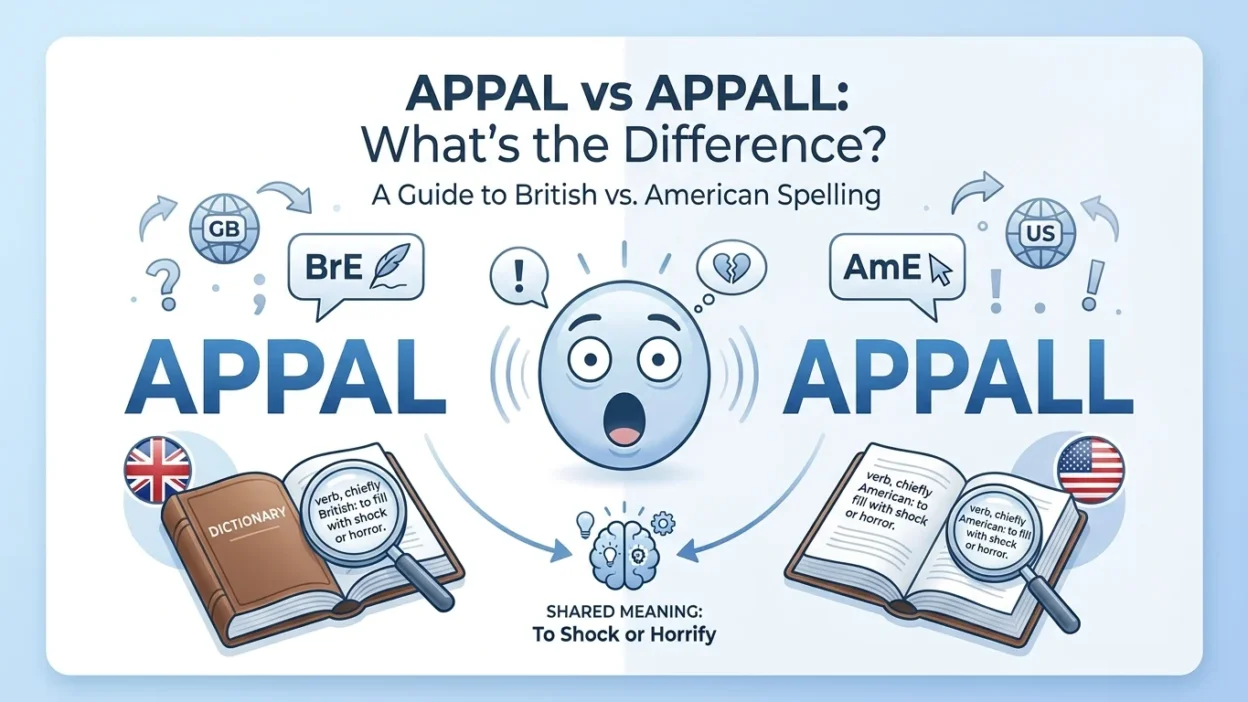
If you have ever wondered whether the correct word is appal or appall, you are not alone. These two spellings look almost identical, and both are legitimate English words. The main difference is not meaning but regional spelling. Both words are verbs that mean to shock, horrify, or deeply upset someone. The only real distinction is where the spelling is preferred.
Appal is the spelling traditionally associated with British English, while appall is the more common spelling in American English. However, appall is also accepted in British English, so the distinction is not absolute. Understanding this small spelling variation can help you write more naturally for your intended audience and avoid unnecessary spelling corrections. In this guide, we will explain the meaning, pronunciation, usage, examples, common mistakes, and the difference between British and American English.
Quick Answer
Appal and appall have the same meaning: to shock, horrify, or greatly disturb someone. Appal is commonly preferred in British English, while appall is especially common in American English. Neither spelling changes the word’s meaning.
Why People Confuse It
The confusion comes from the fact that appal and appall differ by only one letter.
Both spellings are pronounced the same and function as verbs. They describe a strong feeling of shock, horror, or disgust.
For example:
- The news appalled everyone.
- The news appalled everyone.
The pronunciation and meaning remain unchanged.
The important point is that English spelling varies between regions. Similar differences appear in pairs such as:
- travelled / traveled
- cancelled / canceled
- labelled / labeled
- modelling / modeling
So, appal vs appall is primarily a matter of spelling preference rather than vocabulary or grammar.
First Word: Appal
Appal is a verb meaning to shock, horrify, or deeply dismay someone.
It is particularly associated with British English.
Meaning of appal
If something appals you, it causes you to feel extremely shocked or disturbed.
Examples:
- The cruelty of the incident appalled the public.
- Her behavior appalled her parents.
- I was appalled by the condition of the building.
Word forms
You may encounter several forms of appal:
- appal — base form
- appals — third person singular
- appalled — past tense and past participle
- appalling — present participle/adjective
Notice that even when the base form has one l, the past tense has two l’s:
appal → appalled
This spelling pattern can sometimes make the word seem inconsistent, but it follows British spelling conventions.
Second Word: Appall
Appall is also a verb meaning to shock, horrify, or greatly disturb.
It is especially common in American English, although it is also used and accepted in British English.
Meaning of appall
If something appalls you, it causes a powerful negative emotional reaction.
Examples:
- The decision appalled many citizens.
- The amount of waste appalls environmentalists.
- We were appalled by what we saw.
Word forms
The common forms are:
- appall
- appalls
- appalled
- appalling
The double l is retained in the base form.
Comparison Table
| Feature | Appal | Appall |
| Part of speech | Verb | Verb |
| Meaning | To shock or horrify | To shock or horrify |
| Pronunciation | Same | Same |
| British English | Common | Also accepted |
| American English | Less common | Common |
| Past tense | Appalled | Appalled |
| Present participle | Appalling | Appalling |
| Meaning difference | None | None |
| Main distinction | Regional spelling preference | Regional spelling preference |
When to Use Each
Choosing between appal and appall is mainly about your target variety of English.
Use “appal” when:
- You are writing primarily for a British audience.
- You are following British spelling conventions.
- Your school, workplace, publication, or style guide prefers British English.
Example:
The findings appalled researchers across the country.
The base form would be:
The findings appal researchers.
Use “appall” when:
- You are writing primarily for an American audience.
- You are following American spelling conventions.
- Your publication or organization uses American English.
Example:
The findings appall researchers across the country.
The easiest rule
British English → appal is common
American English → appall is common
But remember: appall is not necessarily wrong in British English.
Examples
Here are practical examples showing how the word is used in sentences.
- The level of violence appalled everyone in the community.
- His cruel treatment of the animals appalled me.
- The report may appal readers who are unfamiliar with the situation.
- The shocking photographs appalled the public.
- Her careless attitude appalls her colleagues.
- We were appalled by the amount of food that had been wasted.
- The decision to close the hospital appalled local residents.
- The conditions inside the facility appalled the inspectors.
- Such dishonesty would appal anyone who values fairness.
- The news appalled people around the world.
- I was appalled to hear what had happened.
- The documentary is likely to appall some viewers.
- His behavior appalled his closest friends.
- The extent of the damage appalled the rescue workers.
Appal vs appall in a sentence
Because the meanings are identical, you can generally replace one with the other:
The situation appalled the residents.
The present tense versions would be:
The situation appals the residents.
The situation appalls the residents.
The choice depends on the spelling convention you are following.
Common Mistakes
1. Assuming one spelling is always wrong
It is incorrect to assume that appal or appall is universally the only correct spelling.
Both exist in standard English.
2. Thinking they have different meanings
They do not. Both mean to shock, horrify, or deeply disturb.
3. Forgetting the past tense spelling
The past tense is:
appalled
not appaled.
The present participle is:
appalling
not appaling.
4. Mixing spelling systems unnecessarily
If you are writing an American English article, consistently using British spellings can make the text look inconsistent. The same applies in reverse.
Try to follow the spelling conventions of your intended audience.
5. Confusing “appall” with “appeal”
Appall means to horrify or shock.
Appeal can mean to attract, request, or formally challenge a decision.
These words have completely different meanings.
Memory Trick
Here is an easy way to remember appal vs appall:
America likes the extra L: appall.
Think of American spelling as giving the word an additional L.
For British English, remember:
British English often trims it to appal.
You can also remember that both versions have the same meaning, so the spelling—not the definition—is what you need to focus on.
American vs British English
The key difference is regional spelling preference.
In American English, appall is the standard and more familiar spelling.
In British English, appal is traditionally preferred, although appall is also found and accepted.
This reflects a broader pattern in English spelling. British English often uses different conventions for doubling consonants compared with American English.
For example:
- British: travelled → American: traveled
- British: cancelled → American: canceled
- British: labelled → American: labeled
- British: appal → American: appall
Therefore, if you are writing for an international audience, either form can be understood. If consistency matters, choose one spelling system and use it throughout your document.
Similar Words
Several words have meanings related to appal/appall:
Horrify
To cause intense shock, fear, or disgust.
The details of the crime horrified the investigators.
Shock
To cause someone to feel surprised or deeply disturbed.
The announcement shocked the entire team.
Dismay
To cause someone to feel worried, disappointed, or distressed.
The unexpected result dismayed the players.
Stun
To leave someone extremely surprised or shocked.
The unexpected victory stunned the audience.
Repulse
To cause strong dislike or disgust.
The behavior repulsed everyone at the meeting.
Although these words overlap in meaning, appal/appall often suggests a particularly strong reaction to something shocking, disturbing, or morally offensive.
FAQs
Is “appal” a correct word?
Yes. Appal is a correct English word meaning to shock, horrify, or deeply disturb someone. It is especially common in British English.
Is “appall” a correct word?
Yes. Appall is also correct and has exactly the same meaning. It is especially common in American English.
Is appal British or American?
Appal is traditionally associated with British English. American English generally prefers appall.
Is appall British English?
Yes. Although appal is a traditional British spelling, appall is also used in British English.
What is the past tense of appal?
The past tense is appalled.
The decision appalled the committee.
What is the adjective form of appall?
The common adjective is appalling, meaning extremely shocking, unpleasant, or disturbing.
It was an appalling mistake.
Do appal and appall sound the same?
Yes. They are pronounced the same and have the same meaning. The difference is primarily spelling.
Final Verdict
Appal and appall mean exactly the same thing: to shock, horrify, or deeply disturb. The main difference is regional spelling preference. Appal is more traditionally associated with British English, while appall is the standard choice in American English.
If you are writing for an American audience, choose appall. If you are following British English conventions, appal is a natural choice. Most importantly, be consistent with the variety of English you are using.
Remember This
Appal = British English preference
Appall = American English preference
Both mean “to shock or horrify.”
Conclusion
The appal vs appall distinction is much simpler than it first appears. You do not need to learn two different definitions because both spellings describe the same strong emotional reaction to something shocking, disturbing, or horrifying. The real issue is simply which English spelling convention you are following.
When in doubt, consider your audience. Use appall for standard American English and appal when following traditional British English spelling. Once you connect the extra L with American spelling, this commonly confused word pair becomes easy to remember and use correctly.

Hadley Price creates heartfelt contemporary fiction exploring relationships, hope, resilience, and personal growth. Her emotionally rich storytelling connects with readers through memorable characters and inspiring life experiences worldwide.