
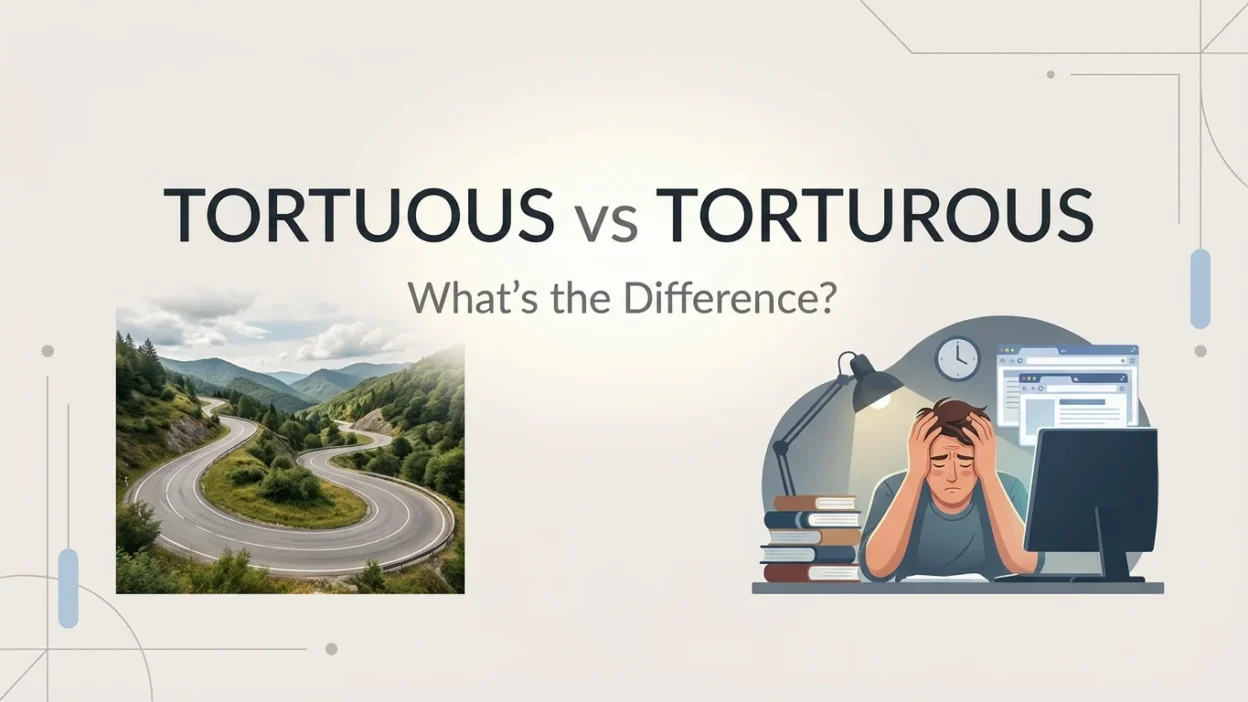
If you have ever hesitated between tortuous and torturous, you are not alone. These two words look and sound remarkably similar, but they describe very different things. One is mainly used for something that is winding, complicated, or full of twists and turns, while the other describes something that causes intense physical or emotional suffering. Choosing the wrong word can subtly change the meaning of your sentence.
The confusion becomes easier to understand when you look at their roots and common uses. Tortuous is often associated with winding roads, complicated arguments, or indirect processes. Torturous, on the other hand, comes from the idea of torture and refers to something extremely painful, distressing, or unbearable. Once you know this distinction, you can quickly decide which word fits your sentence. This guide explains the difference between tortuous and torturous, provides practical examples, and gives you a simple memory trick to remember them.
Quick Answer
Tortuous means winding, twisting, indirect, or complicated. Torturous means extremely painful, distressing, or causing suffering. A tortuous road has many twists and turns, while a torturous experience causes severe physical or emotional pain.
Why People Confuse It
The confusion between tortuous and torturous is understandable because both words:
- Begin with tort-
- Have similar spellings
- Sound somewhat alike
- Can describe difficult situations
- Ultimately relate to the idea of twisting or suffering
However, their meanings have developed in different directions.
Tortuous is connected with the idea of something being twisted or winding. It can describe a physical path, such as a mountain road, or something figurative, such as a complicated explanation.
Torturous is directly associated with torture. It describes something that causes severe pain, suffering, or distress.
A useful distinction is:
Tortuous = full of twists or complications.
Torturous = full of suffering or pain.
So, if a journey takes you through a winding mountain road, it is tortuous. If the journey is unbearably painful or distressing, it may be torturous.
First Word: Tortuous
Tortuous is an adjective meaning full of twists, bends, turns, or complications.
It can be used literally or figuratively.
Literal meaning
When describing a physical route, tortuous means winding or meandering rather than straight.
- a tortuous mountain road
- a tortuous river
- a tortuous trail
- a tortuous route through the hills
For example:
The bus traveled along a tortuous mountain road.
The road is not necessarily painful. It simply contains many curves and turns.
Figurative meaning
Tortuous can also describe something complicated, indirect, or difficult to follow.
For example:
The lawyer presented a tortuous explanation of the case.
Here, tortuous suggests that the explanation was complicated, indirect, or full of twists.
Similarly:
Reaching an agreement was a tortuous process.
This means the process was complicated and involved many difficulties or changes.
Synonyms for tortuous
Depending on context, synonyms include:
- winding
- twisting
- meandering
- indirect
- complicated
- convoluted
- intricate
- circuitous
Second Word: Torturous
Torturous means causing extreme physical or emotional pain, suffering, or distress.
It is closely connected to the noun torture.
For example:
The patient described the recovery period as torturous.
The person experienced severe discomfort or distress.
It can also describe emotional experiences:
Waiting for the examination results was torturous.
Here, the waiting itself caused intense anxiety or emotional suffering.
Synonyms for torturous
Depending on the situation, you could use:
- agonizing
- painful
- excruciating
- unbearable
- distressing
- harrowing
- tormenting
- Suffering inducing
Torturous is generally much stronger than simply saying something was difficult or unpleasant.
Comparison Table
| Word | Meaning | Typical Use | Example |
| Tortuous | Winding, twisting, indirect, or complicated | Roads, paths, arguments, processes | We followed a tortuous road through the mountains. |
| Torturous | Extremely painful or distressing | Experiences, pain, waiting, suffering | The recovery was torturous. |
| Tortuous | Full of twists or complications | Literal and figurative contexts | Negotiations took a tortuous path. |
| Torturous | Causing intense suffering | Physical or emotional contexts | The long wait was torturous. |
The easiest distinction
Ask yourself:
Is it about twists and complications? → Tortuous
Is it about pain and suffering? → Torturous
When to Use Each
Use “tortuous” for winding or complicated things
Choose tortuous when you are talking about:
- winding roads
- twisting paths
- complicated procedures
- indirect reasoning
- convoluted arguments
- complicated negotiations
- difficult political or legal processes
Examples:
The tortuous path led us to a remote village.
The company took a tortuous route toward reaching the agreement.
Use “torturous” for painful experiences
Choose torturous when something causes:
- severe physical pain
- emotional suffering
- intense anxiety
- prolonged distress
- unbearable discomfort
Examples:
The injury made every step torturous.
The uncertainty was torturous for the entire family.
A useful test
Replace the adjective with “winding/complicated.”
If the sentence still makes sense, tortuous may be correct.
If you can replace it with “painful/agonizing,” choose torturous.
Examples
Here are practical examples showing the difference in context.
- The hikers followed a tortuous trail through the forest.
The trail had many twists and turns. - The recovery process was torturous.
The recovery caused severe suffering or discomfort. - The tortuous road climbed steadily toward the mountain village.
The road was winding and irregular. - Waiting several hours for help was torturous.
The experience was extremely distressing. - The negotiations followed a tortuous path before the two sides reached an agreement.
The negotiations were complicated and indirect. - He described the final stage of the illness as torturous.
He experienced intense suffering. - The river takes a tortuous route through the valley.
The river winds and bends through the landscape. - The long period of uncertainty was torturous for the employees.
The uncertainty caused emotional distress. - The author uses a tortuous argument that is difficult to follow.
The argument is complicated and indirect. - The headache became so severe that the afternoon was torturous.
The afternoon was extremely painful or distressing. - We drove along a tortuous coastal road.
The road contained many bends. - The final hours of the journey were torturous because of the extreme heat.
The conditions caused significant suffering. - The tortuous legal process lasted for years.
The process was complicated and lengthy. - For someone afraid of flying, the turbulent flight can be torturous.
The experience can cause intense distress.
Notice that tortuous does not automatically mean “bad.” A winding road can be beautiful and enjoyable. Likewise, torturous specifically emphasizes suffering or distress.
Common Mistakes
Mistake 1: Using “torturous” for a winding road
Incorrect:
We drove down a torturous road full of sharp bends.
Better:
We drove down a tortuous road full of sharp bends.
The road is winding, so tortuous is the appropriate word.
Mistake 2: Using “tortuous” for extreme pain
Incorrect:
The injury caused a tortuous amount of pain.
Better:
The injury was torturous.
Or:
The injury caused excruciating pain.
The intended meaning is suffering, not twisting or complexity.
Mistake 3: Assuming “tortuous” always means painful
This is a particularly common misunderstanding.
Although a tortuous situation can certainly be difficult or frustrating, the word itself does not mean “painful.” Its central idea is twisting, winding, indirectness, or complexity.
Mistake 4: Confusing “torturous” with “tortuous” simply because something is difficult
Not everything difficult is torturous.
A complicated tax form might be tortuous in a figurative sense because the process is complicated. It is torturous only if completing it causes intense suffering or distress.
Memory Trick
Here is an easy way to remember the difference:
Tortuous has “twists.”
Think:
Tortuous → twists and turns
A tortuous road twists and turns.
Torturous has “torture.”
Think:
Torturous → torture → pain
A torturous experience causes suffering.
You can remember it in one sentence:
Tortuous things twist; torturous things hurt.
That simple distinction works for most everyday uses.
American vs British English
There is no major American versus British spelling difference between tortuous and torturous.
Both varieties of English use the same spellings and generally maintain the same distinction in meaning.
The important issue is not regional English but context.
For example, both American and British speakers can naturally say:
The road was tortuous.
And:
The experience was torturous.
The pronunciation may vary slightly according to accent, but the fundamental difference between the words remains the same.
Similar Words
Several related words can make this distinction easier to understand.
Tortuous vs convoluted
Convoluted usually means complicated, intricate, or difficult to follow.
The instructions were convoluted.
Tortuous can have a similar figurative meaning, especially when describing a complicated process, argument, or route.
Tortuous vs circuitous
Circuitous means taking a longer or less direct route.
We took a circuitous route to avoid traffic.
Tortuous emphasizes twisting, winding, or complexity.
Torturous vs painful
Painful is a broad word for something that causes pain.
Torturous is stronger and often suggests extreme or prolonged suffering.
The injection was painful.
The recovery period was torturous.
Torturous vs agonizing
Agonizing is also a strong word for severe physical or emotional suffering.
The wait was agonizing.
The experience was torturous.
These words can overlap, although their tone and context may differ.
Tortuous vs tortured
These are also worth keeping separate.
Tortuous describes something winding, complicated, or indirect.
Tortured can describe someone who has suffered greatly, or something distorted or strained.
For example:
The road was tortuous.
He looked tortured by guilt.
FAQs
1. Is it “tortuous” or “torturous”?
Both words are correct, but they have different meanings. Tortuous means winding, twisting, indirect, or complicated. Torturous means extremely painful, distressing, or causing suffering.
2. Is a winding road tortuous or torturous?
A winding road is tortuous. The word describes its twists, bends, and irregular route. You would use torturous only if you specifically wanted to emphasize that traveling on the road was extremely painful or distressing.
3. Does tortuous mean painful?
Not usually. Tortuous primarily means winding, twisting, indirect, or complicated. It can describe something difficult, but it does not directly mean painful.
4. Does torturous mean complicated?
Not exactly. Torturous means causing severe pain, suffering, or distress. If you mean that something is complicated or difficult to follow, tortuous is usually the better choice.
5. Is “torturous experience” correct?
Yes. Torturous experience is correct when an experience causes intense physical or emotional suffering.
For example:
The long recovery was a torturous experience.
6. Can tortuous be used figuratively?
Yes. Tortuous can describe complicated or indirect reasoning, negotiations, procedures, arguments, and processes.
For example:
The company went through a tortuous negotiation process.
7. What is an easy way to remember tortuous and torturous?
Remember: tortuous = twists, while torturous = torture and pain. A tortuous road twists; a torturous experience hurts.
Final Verdict
The difference between tortuous and torturous becomes straightforward once you focus on the idea behind each word. Tortuous describes something that twists, winds, or follows a complicated and indirect course. It works for physical routes as well as figurative ideas such as arguments and processes.
Torturous, by contrast, is about suffering. Use it when an experience, situation, or condition causes severe physical or emotional pain. When in doubt, ask whether you mean “twisting/complicated” or “painful/agonizing.” That quick test will usually lead you to the correct word.
Remember This
Tortuous = twists, turns, and complications.
Torturous = torture, pain, and suffering.
Tortuous things twist; torturous things hurt.
Conclusion
Although tortuous and torturous look almost identical, they serve different purposes in English. A tortuous road winds through a landscape, a tortuous argument may be complicated, and a tortuous process may involve many twists and difficulties. The word is fundamentally about winding or complexity.
A torturous experience, meanwhile, is one that causes serious physical or emotional suffering. Remembering the connection between torturous and torture makes the distinction much easier. Master this small difference, and your writing will become more precise whenever you need to describe complicated paths or genuinely painful experiences.

Willow Evans writes uplifting fantasy stories filled with magical worlds, courageous heroes, and meaningful life lessons. Her imaginative books encourage creativity, kindness, and hope in readers of all ages.