
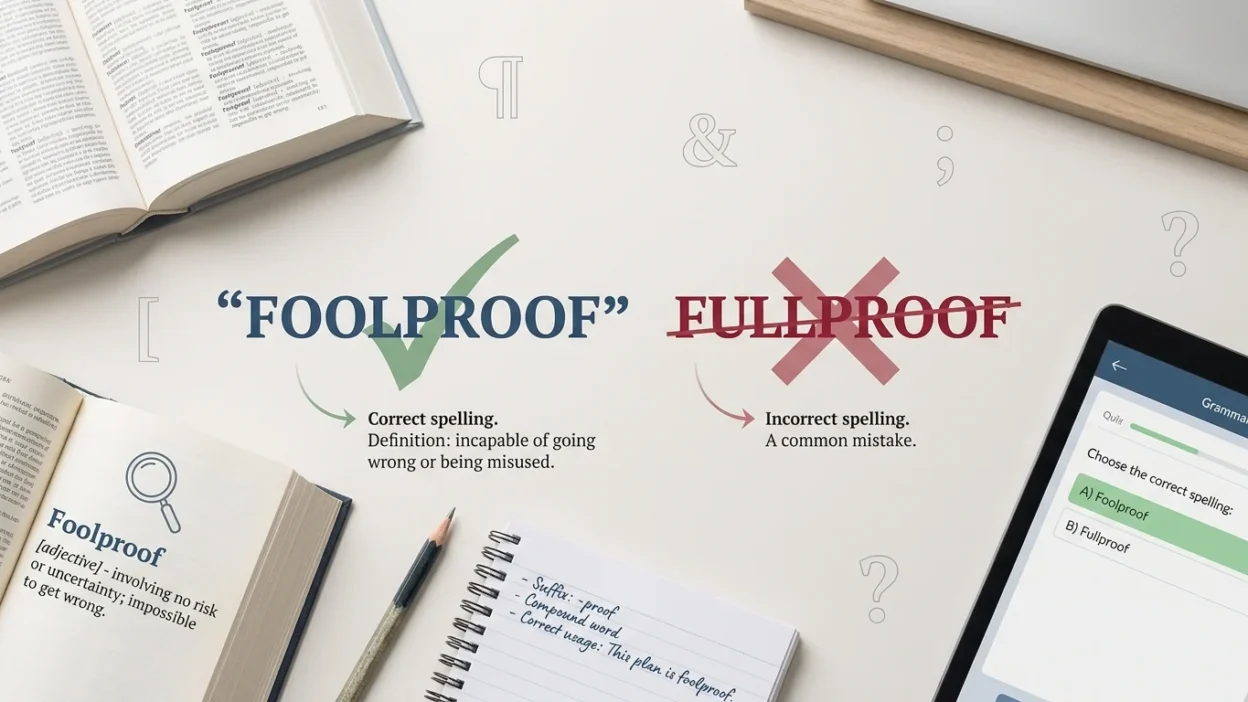
If you have ever wondered whether the correct spelling is “foolproof” or “fullproof,” you are not alone. These two forms look and sound similar, especially when spoken quickly, but they do not have the same status in standard English. One is a well established English word, while the other is generally a misspelling. Knowing the difference can help you avoid an easy spelling mistake in emails, essays, professional writing, and everyday communication.
The correct word is foolproof. It describes something designed to be extremely easy to use or understand, so that even an inexperienced person is unlikely to make a mistake. For example, you might call a set of instructions “foolproof” if they are so clear that almost anyone can follow them successfully. Fullproof is not the standard spelling of this word. In most contexts, it is simply an incorrect version of foolproof. Let’s look at the meaning, usage, examples, common mistakes, and an easy memory trick to make the distinction stick.
Quick Answer
Foolproof is the correct standard English word. It means something is very simple, reliable, or designed to prevent mistakes. Fullproof is generally a misspelling and should not be used when you mean “foolproof.” Remember: the correct spelling contains fool + proof.
Why People Confuse It
The confusion between foolproof and fullproof mainly comes from pronunciation and the visual similarity between the words.
When people hear “foolproof,” the two parts can blend together in normal speech. Someone unfamiliar with the word may assume that it contains full rather than fool.
There is also a logical sounding reason for the mistake. If something is extremely reliable, a writer might naturally think it is “full of proof” or completely proven. However, that is not how foolproof was formed.
The word combines:
- fool — a person who may make a mistake or lack experience
- proof — resistant to or protected against something
So foolproof literally suggests something that is resistant to mistakes by a fool.
Why “fullproof” looks convincing
“Fullproof” resembles legitimate compounds such as:
- full length
- full time
- full scale
- full proof, if interpreted literally
But resemblance does not make a spelling standard. When the intended meaning is “unlikely to fail or cause mistakes,” foolproof is the established word.
First Word: Foolproof
Foolproof is the correct word.
It is an adjective used to describe something that is designed to be so simple, reliable, or effective that it is very difficult to use incorrectly or make a mistake with.
Definition of foolproof
Foolproof means:
Extremely easy to use or understand and unlikely to fail because of mistakes.
For example:
- “The new software has a foolproof interface.”
- “She created a foolproof plan for organizing the event.”
- “These instructions are practically foolproof.”
The word does not literally mean that something can never fail. It is often used to emphasize that a method, system, or process is highly reliable and difficult to get wrong.
Foolproof as an adjective
The most common use of foolproof is as an adjective:
- a foolproof method
- a foolproof plan
- a foolproof system
- a foolproof recipe
- a foolproof solution
- a foolproof strategy
- a foolproof design
It can appear before a noun or after a linking verb:
- “This is a foolproof method.”
- “The method is foolproof.”
Is foolproof one word?
Yes. Foolproof is normally written as one word.
Correct:
- foolproof
- foolproof instructions
- a foolproof system
Incorrect in standard usage:
- fullproof
- fool proof
Second Word: Fullproof
Fullproof is generally not the correct spelling when you mean “foolproof.”
If you write:
“This is a fullproof method.”
most readers will understand what you mean, but the spelling is considered incorrect in standard English for this intended meaning.
Why is “fullproof” incorrect?
The established word is foolproof, not fullproof.
The word is connected to the idea of something being resistant to mistakes, hence fool + proof.
“Fullproof” does not function as the standard spelling of that adjective.
What should you write instead?
Use foolproof:
❌ “We need a fullproof solution.”
✅ “We need a foolproof solution.”
❌ “These are fullproof instructions.”
✅ “These are foolproof instructions.”
If you see fullproof in informal writing, social media, or online comments, it is usually best understood as a spelling error rather than a different English word.
Comparison Table
| Word | Correct? | Meaning | Example |
| Foolproof | Yes | Very easy to use, understand, or follow; unlikely to result in mistakes | “This is a foolproof method.” |
| Fullproof | No, generally | Usually an incorrect spelling of “foolproof” | “This is a fullproof method.” ❌ |
Foolproof vs Fullproof at a glance
The easiest way to remember the distinction is:
Foolproof = correct
Fullproof = generally incorrect
If you want to describe something that is almost impossible to get wrong, choose foolproof.
When to Use Each
When to use “foolproof”
Use foolproof when describing something that is:
- simple to operate
- easy to understand
- difficult to misuse
- designed to prevent mistakes
- highly reliable
- unlikely to fail because of user error
For example:
“The instructions are foolproof.”
This means the instructions are so clear that users are unlikely to make mistakes while following them.
You can use the word in casual, academic, technical, business, and professional contexts.
When not to use “fullproof”
Avoid fullproof when you mean:
- foolproof
- reliable
- difficult to misuse
- unlikely to fail
- easy to follow
In these situations, replace fullproof with foolproof.
A useful distinction
If your intended meaning is “designed so that people cannot easily make mistakes,” use foolproof.
If you actually mean something related to full proof in a literal context, you may be able to use those words separately depending on the sentence. But that is a different construction from the standard adjective foolproof.
For example:
“The lawyer presented full proof of the claim.”
Even here, however, full proof would need to be justified by the intended meaning and context. It is not an alternative spelling of foolproof.
Examples of Foolproof vs Fullproof
Here are more than ten examples to show how the correct word works in real sentences.
1. A foolproof plan
“We need a foolproof plan before starting the project.”
The plan is intended to minimize mistakes and unexpected problems.
2. Foolproof instructions
“The manufacturer provides foolproof instructions for assembling the table.”
The instructions are very easy to follow.
3. A foolproof method
“There is no completely foolproof method, but this approach greatly reduces errors.”
Here, foolproof means highly reliable rather than literally perfect.
4. A foolproof recipe
“This is a foolproof recipe for homemade bread.”
The recipe is considered easy to follow and difficult to get wrong.
5. A foolproof system
“The company introduced a foolproof system for tracking orders.”
The system is designed to reduce human error.
6. A foolproof solution
“She came up with a foolproof solution to the problem.”
The solution appears highly dependable.
7. A foolproof way to remember something
“Writing down your appointments is a foolproof way to avoid forgetting them.”
The speaker emphasizes reliability.
8. Foolproof design
“The device has a foolproof design that makes it easy for beginners to operate.”
The design minimizes the possibility of user mistakes.
9. A foolproof strategy
“There is no foolproof strategy for predicting market behavior.”
This example shows that foolproof can also be used negatively or with a limitation.
10. Foolproof instructions for beginners
“The tutorial contains foolproof instructions for first time users.”
The instructions are especially easy for inexperienced users.
11. A foolproof safety procedure
“The laboratory developed a foolproof safety procedure.”
The procedure is intended to reduce the risk of mistakes.
12. Nothing is completely foolproof
“Remember that no security system is completely foolproof.”
This is a common and useful expression. It means that even a very reliable system can potentially fail.
13. Incorrect use of “fullproof”
“We need a fullproof plan.”
❌ Incorrect if the intended meaning is “a plan that is difficult to get wrong.”
Correct:
“We need a foolproof plan.”
14. Another incorrect example
“She gave me fullproof instructions.”
❌ Incorrect in the intended sense.
Correct:
“She gave me foolproof instructions.”
Common Mistakes
Mistake 1: Writing “fullproof”
This is the most common error.
❌ “The process is fullproof.”
✅ “The process is foolproof.”
The correct spelling contains fool, not full.
Mistake 2: Writing “fool proof”
Because the word has two recognizable parts, some writers separate them.
❌ “This is a fool proof solution.”
✅ “This is a foolproof solution.”
The standard adjective is written as one word.
Mistake 3: Assuming foolproof means perfect
Foolproof is often used to mean extremely reliable, but it does not necessarily mean absolutely impossible to fail.
For example:
“There is no foolproof way to predict the future.”
This sentence makes perfect sense because even a highly reliable method may have limitations.
Mistake 4: Thinking “fullproof” has a different meaning
In most everyday uses, fullproof is simply a misspelling of foolproof, not a separate word with a distinct meaning.
Mistake 5: Confusing “foolproof” with “bulletproof”
These words can overlap in meaning, but they are not interchangeable in every context.
A foolproof system is difficult for users to get wrong.
A bulletproof argument is often described as extremely strong or difficult to challenge, while the literal meaning relates to resistance to bullets.
Memory Trick
Here is a simple trick:
Think: “A fool can’t get it wrong.”
Fool + proof = foolproof
Imagine a product with such clear instructions that even someone with very little experience can use it correctly.
That is foolproof.
You can also remember:
Foolproof has “fool” because it prevents fools from making mistakes.
So when you are deciding between foolproof and fullproof, ask yourself:
“Am I talking about something that is difficult for a person to get wrong?”
If the answer is yes, choose foolproof.
Quick spelling test
Remember these three:
- foolproof ✅
- fullproof ❌
- fool proof ❌
The correct form is one word with two O’s in “fool.”
American vs British English
There is no major American versus British spelling difference between foolproof and fullproof.
Both American English and British English use foolproof as the standard spelling.
For example:
American English:
“The software is foolproof.”
British English:
“The software is foolproof.”
The spelling remains the same.
The word can be used in both varieties of English in everyday conversation, professional writing, technical documentation, educational material, and journalism.
So if you are writing for an American or British audience, you do not need to change foolproof to another spelling.
Similar Words
Several words are related to foolproof, although their meanings are not exactly identical.
Fail safe
Fail safe describes something designed to remain safe or prevent serious problems if a failure occurs.
Example:
“The machine has a fail safe mechanism.”
Reliable
Reliable means dependable or consistently trustworthy.
Example:
“This is a reliable method for collecting data.”
A reliable method may not necessarily be foolproof.
Idiot proof
Idiot proof is an informal expression that means very difficult to misuse or get wrong.
Example:
“The controls are almost idiot proof.”
However, idiot proof can sound insulting or insensitive, so foolproof is often a better choice in professional communication.
Fail proof
Fail proof is sometimes used to mean unlikely to fail, although foolproof and fail safe are generally more established choices depending on the intended meaning.
Simple
Something described as simple is easy to understand or do.
Example:
“The process is simple.”
However, simple does not necessarily mean designed to prevent mistakes.
User friendly
User friendly means easy and convenient for people to use.
Example:
“The website has a user friendly interface.”
A user friendly system can be foolproof, but the two expressions emphasize different qualities.
Final Verdict
The answer is straightforward: foolproof is the correct standard English word when you mean something that is extremely easy to use, understand, or follow and unlikely to result in mistakes.
Fullproof is generally a misspelling of foolproof. It should not be used as an alternative spelling in standard English writing. If you are writing an email, article, essay, report, instruction manual, or professional document, choose foolproof.
Remember This
Foolproof = correct
Fullproof = generally incorrect
Think of the word as fool + proof: something is so well designed that even a person likely to make mistakes can use it successfully.
FAQs
1. Is it foolproof or fullproof?
Foolproof is the correct standard spelling. Fullproof is generally a misspelling when used to mean something that is difficult to get wrong.
2. What does foolproof mean?
Foolproof means extremely easy to use, understand, or follow and designed so that mistakes are unlikely. For example, “The instructions are foolproof.”
3. Is fullproof a real word?
Fullproof is not generally recognized as the standard spelling of the adjective meaning “unlikely to fail or cause mistakes.” In most cases, writers who use it mean foolproof.
4. Is foolproof one word?
Yes. Foolproof is normally written as one word. “Fool proof” is not the standard spelling when the word is being used as an adjective.
5. Can you say “a foolproof plan”?
Yes. A foolproof plan is a natural and grammatically correct phrase. It means a plan designed to minimize mistakes or problems.
6. Is foolproof the same as perfect?
Not exactly. Foolproof means highly reliable or difficult to get wrong, but it does not necessarily mean absolutely perfect or incapable of failure.
7. Is foolproof used in American and British English?
Yes. Foolproof is standard in both American and British English, with no major spelling difference between the two varieties.
Conclusion
When choosing between foolproof and fullproof, there is no need to overthink the answer. Foolproof is the established English word, and it describes something that is very easy to use, understand, or follow and therefore unlikely to result in mistakes. It can describe a plan, system, recipe, method, strategy, design, or set of instructions.
The easiest way to remember the spelling is to focus on fool + proof. If something is “foolproof,” it is designed to prevent even an inexperienced or mistake prone person from getting it wrong. Whenever you are tempted to write fullproof, pause and remember that the correct form is foolproof.
Remember This:
Foolproof = correct spelling and “difficult to get wrong.”
Fullproof = generally a misspelling.

Nova Turner specializes in imaginative science fiction blending futuristic technology, thrilling adventures, and powerful human emotions. Her innovative storytelling inspires curiosity, creativity, and exploration among readers of every age.