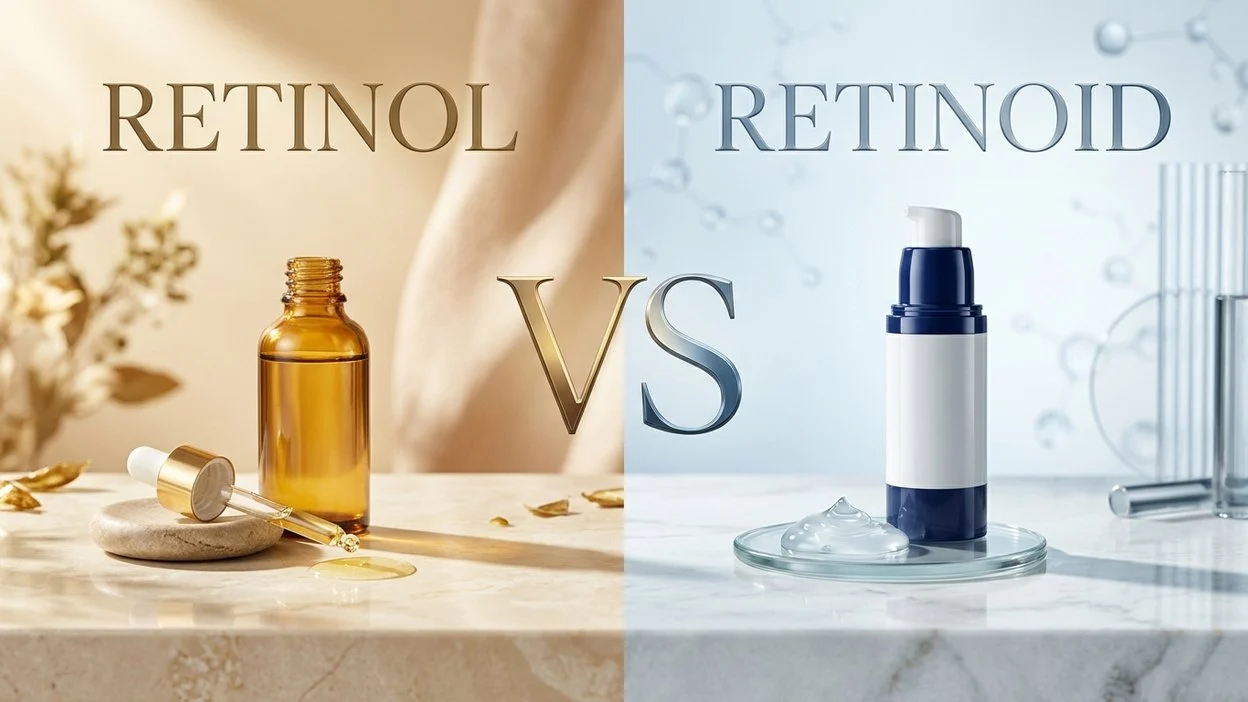
When comparing retinol vs retinoid, the main difference is that retinol is one specific type of retinoid. Retinoids are a family of skincare ingredients derived from vitamin A or related to it. They are widely used to improve acne, fine lines, uneven skin tone, and skin texture. Although the terms sound similar, they do not mean exactly the same thing.
Understanding the difference between retinol and retinoids can help you choose a skincare product that suits your skin type and goals. Some options are available without a prescription, while others require medical advice or a prescription, depending on the product and country. Their strength, effectiveness, and risk of irritation can also differ. Whether you are new to skincare or already use active ingredients, learning how these products work will help you make a more informed decision.
Quick Answer: Retinol vs Retinoid
Retinol is a type of retinoid, not a completely separate ingredient. Retinoid is the umbrella term for vitamin A-related skincare ingredients, including retinol, retinal, and tretinoin. Retinol is commonly found in over-the-counter products and usually works more gradually. Prescription retinoids, such as tretinoin, can act more directly and may be more irritating. The right choice depends on your skin concerns, sensitivity, and treatment goals.
Why Do People Confuse Retinol and Retinoid?
People often confuse these terms because skincare brands and beauty articles sometimes use them interchangeably. Both refer to ingredients associated with skin renewal, acne treatment, and improvements in the appearance of aging skin.
The confusion also comes from the fact that retinol belongs to the retinoid family. This relationship is similar to how a rose is a type of flower: every rose is a flower, but not every flower is a rose.
Another reason is that retinol and prescription retinoids may appear in products designed for similar purposes. However, they can differ in potency, formulation, availability, and the amount of time needed to see results.
First Word: What Is Retinol?
Retinol is a vitamin A derivative used in skincare products to improve the appearance and condition of the skin. It is especially popular in products targeting fine lines, uneven skin tone, rough texture, and mild acne concerns.
How Does Retinol Work?
When applied to the skin, retinol is converted into retinaldehyde (retinal) and then into retinoic acid. Retinoic acid is the form that interacts with specific receptors in skin cells.
Because retinol requires these conversion steps, it generally acts less directly than prescription tretinoin.
Retinol may help:
- Reduce the appearance of fine lines.
- Improve uneven skin tone and texture.
- Support skin cell turnover.
- Reduce clogged pores and some forms of acne.
- Improve the appearance of certain dark spots over time.
Results depend on the formulation, concentration, consistency of use, and individual skin response.
Is Retinol Strong or Gentle?
Retinol is often considered a beginner-friendly option compared with stronger prescription retinoids. However, it can still cause dryness, redness, peeling, burning, or irritation.
A low-strength product introduced gradually is often a sensible starting point for someone new to retinol. People with sensitive skin may need a gentler alternative or advice from a dermatologist.
Second Word: What Is a Retinoid?
A retinoid is a broad category of vitamin A-related ingredients used in skincare and dermatology. Retinol is one member of this category, alongside retinaldehyde, tretinoin, adapalene, and other compounds.
Retinoids differ in their chemical structures, how they work, their approved uses, and their potential to irritate the skin.
Common Types of Retinoids
1. Retinol
Retinol is widely used in nonprescription anti-aging products. The skin must convert it into its active form before it can work.
2. Retinaldehyde (retinal)
Retinal requires one conversion step to become retinoic acid. It is often marketed as an intermediate option between retinol and tretinoin, although the real-world effects depend on the formulation and concentration.
3. Tretinoin
Tretinoin is a prescription retinoid in many countries. It is already retinoic acid, so it does not require conversion from retinol. It is used for conditions such as acne and, in certain formulations, photoaging.
4. Adapalene
Adapalene is a synthetic retinoid commonly used to treat acne. Some formulations are available without a prescription in certain countries, while others require one.
5. Tazarotene
Tazarotene is a prescription retinoid used for specific skin conditions, including acne and plaque psoriasis. It can be irritating and requires appropriate medical guidance.
Are All Retinoids Stronger Than Retinol?
No. Retinol is itself a retinoid, so it is inaccurate to say that every retinoid is stronger than retinol.
Different retinoids have different levels of activity and different uses. Prescription retinoids such as tretinoin may act more directly, but the outcome also depends on the formulation, dose, treatment goal, and skin tolerance.
Retinol vs Retinoid: Comparison Table
| Feature | Retinol | Retinoids |
| Meaning | One specific vitamin A-related ingredient | The entire family of related ingredients |
| Relationship | A type of retinoid | Includes retinol and other compounds |
| Common examples | Retinol skincare serums and creams | Retinol, retinal, tretinoin, adapalene, tazarotene |
| Availability | Commonly available over the counter | Depends on the specific ingredient and country |
| Main uses | Fine lines, uneven texture, some acne concerns | Acne and other skin concerns, including photoaging for certain products |
| How it works | Requires conversion into retinoic acid | Mechanism varies by ingredient |
| Irritation risk | Can cause dryness, redness, and peeling | Varies; some options can be highly irritating |
| Beginner suitability | Often a practical starting point | Depends on the specific retinoid and medical need |
| Time to see results | Usually several weeks or longer | Varies by product and condition |
| Best choice | Often suitable for gradual cosmetic improvement | Depends on the treatment goal and individual circumstances |
When Should You Use Retinol or Another Retinoid?
The best choice depends on what you want to treat, how sensitive your skin is, and whether you need a cosmetic product or a medical treatment.
When Should You Choose Retinol?
Retinol may be a reasonable option if you:
- Want to improve the appearance of fine lines.
- Have uneven skin texture or tone.
- Prefer a widely available, nonprescription skincare ingredient.
- Are beginning a retinoid routine for cosmetic purposes.
- Want to introduce an active ingredient gradually.
Start with a low-strength product and use it sparingly at first. Follow the product instructions and increase use only as your skin tolerates it.
When Should You Consider Another Retinoid?
A different retinoid may be more appropriate if you:
- Have persistent acne that needs targeted treatment.
- Need a treatment recommended by a dermatologist.
- Have a diagnosed skin condition for which a specific retinoid is indicated.
- Have tried nonprescription products without sufficient improvement.
For example, adapalene is commonly used for acne, while tretinoin may be prescribed for acne and certain signs of sun-related skin aging. The appropriate choice depends on your skin and the product’s approved uses.
Can You Use Retinol Every Day?
Some people can eventually use retinol daily, but daily application is not necessary for everyone. Beginners may find it easier to start two or three nights a week and adjust according to their skin’s response.
Avoid applying more than the product instructions recommend. Using a larger amount does not guarantee faster results and may increase irritation.
Can You Use Retinol and Tretinoin Together?
Using retinol and tretinoin together is generally unnecessary and may increase irritation. Both belong to the retinoid family, and combining them without professional guidance can make dryness, redness, and peeling more likely.
Choose a suitable treatment rather than layering multiple retinoids simply to get faster results.
12 Examples of Retinol and Retinoid in Sentences
These examples show how to use the terms correctly in everyday English and skincare discussions.
- Retinol: I started using retinol to improve the appearance of fine lines.
- Retinoid: My dermatologist recommended a retinoid for my acne.
- Retinol: This night cream contains retinol.
- Retinoid: Retinoid is the general term for a family of vitamin A-related compounds.
- Retinol: Beginners may prefer to start with a low-strength retinol product.
- Retinoid: Some retinoids require a prescription, depending on the ingredient and country.
- Retinol: She introduced retinol gradually to reduce skin irritation.
- Retinoid: Adapalene is a retinoid commonly used to treat acne.
- Retinol: Retinol may help improve uneven skin texture over time.
- Retinoid: The doctor explained how the prescribed retinoid should be used.
- Retinol: He checked the product label to find the retinol concentration.
- Retinoid: Tretinoin is a retinoid that contains retinoic acid.
These examples highlight the key distinction: retinol refers to a particular ingredient, while retinoid refers to a larger group.
Common Mistakes When Comparing Retinol and Retinoids
Mistake 1: Thinking Retinol and Retinoids Are Completely Different
This is the most common mistake. Retinol is a member of the retinoid family.
Correct understanding: Retinol is a retinoid, but other retinoids are not necessarily retinol.
Mistake 2: Assuming All Retinoids Require a Prescription
Prescription requirements vary by ingredient, formulation, and country. Some retinoid products, including certain adapalene formulations, are available without a prescription in some markets.
Correct understanding: Check the specific product and local regulations.
Mistake 3: Believing Stronger Always Means Better
A more potent treatment may cause more irritation without necessarily being the best choice for your needs.
Correct understanding: The right product balances effectiveness, tolerability, and the condition being treated.
Mistake 4: Expecting Immediate Results
Retinoids generally require consistent use over weeks or months, depending on the condition and formulation.
Correct understanding: Give an appropriate treatment time to work, and seek medical advice if your skin becomes severely irritated or your condition worsens.
Mistake 5: Ignoring Sun Protection
Retinoid use can make skin more prone to irritation. Sun protection is important, especially when treating signs of sun damage.
Correct understanding: Use broad-spectrum sunscreen with SPF 30 or higher during the day and follow your product’s directions.
Mistake 6: Using Too Much Product
Applying extra retinol or using several active ingredients at once can increase irritation.
Correct understanding: Follow the instructions, introduce products gradually, and use a moisturizer if appropriate.
Memory Trick: How to Remember Retinol vs Retinoid
Use this simple rule:
Retinol = one ingredient. Retinoid = the whole family.
Imagine a family tree. Retinoid is the family name, and retinol is one member of that family. Other members include retinal, tretinoin, adapalene, and tazarotene.
Remembering this relationship makes it easier to understand product labels and skincare advice.
American vs British English
The words retinol and retinoid have the same spelling and meaning in American and British English.
| Feature | American English | British English |
| Retinol | Retinol | Retinol |
| Retinoid | Retinoid | Retinoid |
| Spelling difference | None | None |
| General usage | Common in skincare and dermatology | Common in skincare and dermatology |
There is no meaningful regional difference in the use of these terms. Both are used internationally in medical writing, skincare discussions, and product descriptions.
Some related words do differ between American and British English. For example, Americans commonly write aging, while British writers often use ageing. This spelling difference does not change the meaning of retinol or retinoid.
Similar Words Related to Retinol and Retinoids
Understanding these related terms can help you read skincare labels and medical advice more confidently.
- Retinal (retinaldehyde): A vitamin A-related ingredient that converts into retinoic acid in one step.
- Retinoic acid: The active form involved in many of the biological effects associated with retinoids.
- Tretinoin: A retinoid that is retinoic acid and is commonly prescribed for acne.
- Adapalene: A synthetic retinoid primarily used to treat acne.
- Tazarotene: A prescription retinoid used for acne and certain other skin conditions.
- Vitamin A: An essential nutrient related to the family of compounds used in retinoid skincare.
- Retinyl palmitate: A vitamin A ester used in some skincare formulations; it differs from retinol and must undergo conversion before becoming retinoic acid.
- Exfoliant: An ingredient or treatment that removes dead skin cells or helps their shedding. Exfoliants and retinoids are not the same thing, although some of their cosmetic benefits may overlap.
Final Verdict: Which Is Better, Retinol or Retinoid?
Neither term is inherently better because retinol is a type of retinoid. The useful comparison is between retinol and specific alternatives, such as retinal, tretinoin, or adapalene.
For someone seeking gradual cosmetic improvement, retinol may be a practical starting point. For persistent acne or a particular skin condition, another retinoid may be more suitable. A healthcare professional can help determine which ingredient fits your needs.
Choose based on your skin concern, product formulation, tolerance, and treatment goals rather than the ingredient’s name alone.
FAQs:
1. Is retinol the same as a retinoid?
No. Retinol is one specific type of retinoid. Retinoid is the broader term for a family of vitamin A-related compounds used in skincare and dermatology.
2. Which is stronger, retinol or retinoid?
The question compares one member of a category with the category itself. Retinoids vary in activity and strength. Tretinoin, for example, acts more directly than retinol because it is already retinoic acid, but the best treatment depends on the product and the condition being treated.
3. Is retinol good for beginners?
Retinol is often a reasonable starting option for people interested in addressing fine lines or uneven skin texture. Begin with a low-strength product, introduce it gradually, and stop or seek advice if significant irritation develops.
4. Is retinol better than tretinoin?
Not necessarily. Retinol is commonly used for cosmetic skincare, while tretinoin is a prescription treatment in many countries for conditions such as acne and certain signs of photoaging. Tretinoin may act more directly, but it can also cause substantial irritation. The better option depends on your needs and tolerance.
5. Can retinol remove acne?
Retinol may help with some acne concerns, but it is not the same as an established acne medication. Adapalene and other treatments may be more appropriate for persistent acne. A dermatologist can help identify a suitable option.
6. How long does retinol take to work?
Some people notice changes in skin texture after several weeks, while improvements in fine lines or uneven pigmentation may take several months. Results vary with the product, concentration, consistency, and individual skin response.
7. Should I use retinol in the morning or at night?
Retinol is commonly used at night, following the product instructions. During the day, apply broad-spectrum sunscreen with SPF 30 or higher. Nighttime use does not remove the need for sun protection.
8. Can I use retinol during pregnancy?
Topical retinoids are generally avoided during pregnancy as a precaution. If you are pregnant or planning a pregnancy, consult your healthcare professional before using retinol or any other retinoid. Do not assume that an over-the-counter product is automatically suitable.
Remember This
- Retinol is one type of retinoid.
- Retinoid is the umbrella term for a family of vitamin A-related ingredients.
- Retinol is commonly available without a prescription.
- Tretinoin and adapalene are different retinoids with different uses and availability.
- Stronger does not automatically mean better.
- Introduce retinoid products gradually and use sunscreen.
- Seek professional advice if you have persistent acne, significant irritation, or questions about whether a retinoid is appropriate for you.
Conclusion:
The difference between retinol and retinoid is mainly a matter of terminology. Retinol is a specific ingredient, while retinoid describes a broader group of vitamin A-related compounds. Both terms are important for understanding skincare products, but they should not be treated as interchangeable in every context. Knowing the difference helps you compare ingredients, understand product labels, and make better-informed skincare decisions.
If you are new to retinoids, retinol may be a suitable starting point for certain cosmetic concerns. If you have persistent acne or another skin condition, a different retinoid may be more appropriate. Focus on your skin’s needs, follow product directions, introduce active ingredients carefully, and consult a qualified healthcare professional when necessary. With the right approach, you can choose a treatment that supports your goals while reducing the risk of unnecessary irritation.

Hadley Price creates heartfelt contemporary fiction exploring relationships, hope, resilience, and personal growth. Her emotionally rich storytelling connects with readers through memorable characters and inspiring life experiences worldwide.