Indolence and insolence are easy to confuse because they look and sound remarkably similar, but they describe completely different kinds of behavior. Indolence is connected with laziness, inactivity, or an unwillingness to make an effort. Insolence, on the other hand, refers to rude, disrespectful, or boldly impudent behavior, especially toward someone who deserves respect. In simple terms, an indolent person avoids work, while an insolent person may speak or behave disrespectfully.
Knowing the difference between these two words can make your English more precise, particularly in formal writing, workplace communication, academic contexts, and descriptions of someone’s character. Both are nouns, although their related adjectives indolent and insolent are more commonly used in everyday sentences. This guide explains their meanings, pronunciation, usage, examples, common mistakes, and a simple memory trick so you can confidently choose the right word.
Quick Answer
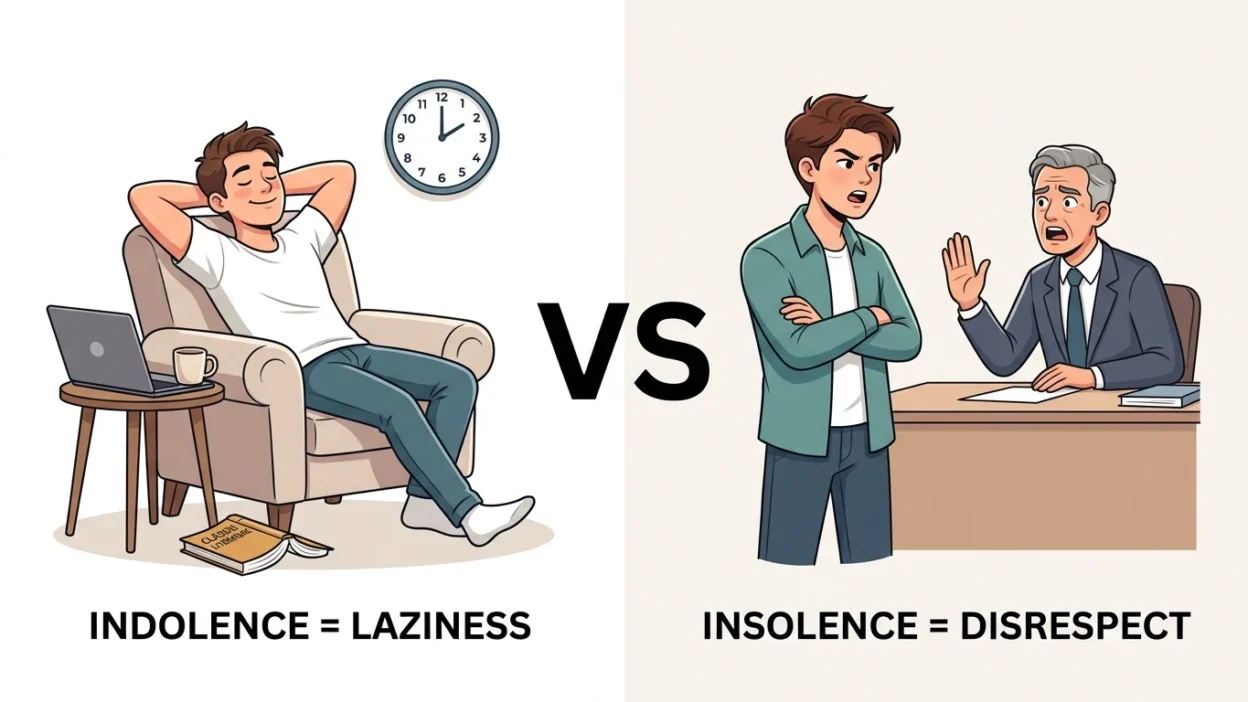
Indolence means laziness or a tendency to avoid effort and activity. Insolence means rude, disrespectful, or impudent behavior. Remember: indolence = inactivity, while insolence = disrespect. An indolent person does not want to work; an insolent person does not show proper respect.
Why People Confuse It
The confusion mainly comes from the similar spelling and pronunciation of indolence and insolence.
Both words:
- Begin with in-
- End with -olence
- Describe negative qualities or behavior
- Have closely related adjective forms: indolent and insolent
However, their meanings are separated by a major distinction:
Indolence concerns effort and activity; insolence concerns attitude and respect.
Consider these two sentences:
- His indolence prevented him from finishing the project.
- His insolence offended the manager.
In the first sentence, the problem is laziness. In the second, the problem is disrespectful behavior.
The words may look like linguistic twins, but they describe very different problems.
First Word: Indolence
Meaning of Indolence
Indolence is a noun meaning laziness, inactivity, or an unwillingness to make an effort.
It often describes someone who habitually avoids work or physical or mental activity. The word can be used in formal writing and usually carries a negative judgment.
Simple definition:
Indolence = a habit or state of being lazy and avoiding effort.
Examples
- His indolence caused him to fall behind in his studies.
- The manager was frustrated by the employee’s indolence.
- Years of indolence had weakened his professional skills.
The adjective is indolent:
- He is too indolent to complete his assignments on time.
- An indolent worker may struggle to meet deadlines.
Synonyms of Indolence
Depending on the context, synonyms include:
- laziness
- inactivity
- idleness
- sluggishness
- lethargy
- apathy
- inactivity
- lack of effort
Indolence is generally more formal than simply saying laziness.
Second Word: Insolence
Meaning of Insolence
Insolence is a noun meaning rude, disrespectful, arrogant, or boldly impudent behavior.
It often describes someone speaking or acting in an offensively disrespectful way toward another person, particularly someone in a position of authority.
Simple definition:
Insolence = disrespectful or offensively bold behavior.
Examples
- The teacher was shocked by the student’s insolence.
- The employee was reprimanded for his insolence.
- She could not tolerate his insolence any longer.
The adjective is insolent:
- The insolent student interrupted the principal.
- His insolent reply surprised everyone in the room.
Synonyms of Insolence
Depending on the situation, synonyms include:
- disrespect
- rudeness
- impudence
- impertinence
- arrogance
- cheekiness
- audacity
Insolence is often associated with behavior that challenges or disregards expected respect.
Comparison Table
| Word | Part of Speech | Meaning | Main Idea | Example |
| Indolence | Noun | Laziness or unwillingness to make an effort | Lack of effort | His indolence affected his grades. |
| Insolence | Noun | Rude or disrespectful behavior | Lack of respect | Her insolence angered the supervisor. |
| Indolent | Adjective | Lazy or inactive | Avoiding work | The indolent employee missed several deadlines. |
| Insolent | Adjective | Rude or disrespectful | Showing disrespect | The insolent employee argued with his supervisor. |
The shortest distinction
Indolence = laziness.
Insolence = disrespect.
That distinction will help you correctly use the words in most situations.
When to Use Each
Use indolence when you are talking about:
- Laziness
- Idleness
- Avoiding work
- Lack of motivation
- Lack of physical or mental effort
- A habit of doing little or nothing
Example:
His indolence kept him from preparing for the examination.
Here, the person failed to put in the necessary effort.
Use insolence when you are talking about:
- Rudeness
- Disrespect
- Impudence
- Arrogant replies
- Defiance toward authority
- Offensive behavior or speech
Example:
The supervisor was offended by the employee’s insolence.
Here, the issue is not laziness. The employee behaved disrespectfully.
A useful test
Ask yourself:
Is the problem that someone will not work?
→ Use indolence.
Is the problem that someone is being rude or disrespectful?
→ Use insolence.
Examples
Here are clear examples showing the difference between indolence and insolence.
- His indolence prevented him from completing the assignment.
→ He was too lazy or inactive to finish it. - The manager criticized the worker’s indolence.
→ The criticism concerned a lack of effort. - Her indolence became obvious when she repeatedly missed deadlines.
→ She consistently failed to make enough effort. - The student’s indolence resulted in poor examination results.
→ The student did not work hard enough. - The teacher would not tolerate the student’s insolence.
→ The student’s behavior was disrespectful. - His insolence toward his parents shocked the entire family.
→ He behaved rudely and disrespectfully. - The officer was offended by the man’s insolence.
→ The man showed disrespect toward the officer. - She responded to the criticism with surprising insolence.
→ Her response was boldly rude or disrespectful. - Indolence can prevent talented people from reaching their potential.
→ Laziness can stop people from making progress. - Insolence can damage relationships in the workplace.
→ Disrespectful behavior can create conflict.
- The student’s indolence was more serious than his lack of ability.
→ His main problem was insufficient effort.
- The supervisor warned the employee about his insolence.
→ The employee was behaving disrespectfully.
- After months of indolence, he decided to change his routine.
→ He had spent months being inactive or lazy.
- The customer’s insolence made it difficult for the staff to help him.
→ His rude behavior created a problem.
- Indolence may feel comfortable in the short term but can have long term consequences.
→ Avoiding effort can eventually cause problems.
- The principal regarded the student’s insolence as unacceptable.
→ The student had behaved disrespectfully.
Common Mistakes
Mistake 1: Using “insolence” to mean laziness
Incorrect:
His insolence caused him to avoid his homework.
If the intended meaning is laziness, indolence is the better word.
Correct:
His indolence caused him to avoid his homework.
Mistake 2: Using “indolence” for rude behavior
Incorrect:
The teacher punished him for his indolence when he insulted her.
If the issue is disrespect, use insolence.
Correct:
The teacher punished him for his insolence when he insulted her.
Mistake 3: Confusing the adjectives
Remember:
- indolent = lazy
- insolent = disrespectful
Compare:
He is indolent and rarely completes his work.
He is insolent and frequently talks back to his supervisor.
Mistake 4: Assuming the similar endings mean similar meanings
The spelling is similar, but the concepts are not.
A person can actually be both indolent and insolent. For example, an employee might avoid doing work and then rudely argue with their manager when confronted.
Memory Trick
Here’s an easy way to remember the difference:
INDOLENCE → INactive
Both indolence and inactive relate to a lack of activity or effort.
Think:
INDOLENCE = I don’t want to work.
INSOLENCE → INSult
Both insolence and insult can involve disrespectful behavior.
Think:
INSOLENCE = I show disrespect.
So remember:
INDOLENCE = lazy.
INSOLENCE = rude.
If you remember only those two words, you will rarely confuse them again.
American vs British English
There is no major difference in meaning between American and British English when it comes to indolence and insolence.
Both varieties use:
- indolence for laziness or inactivity
- insolence for disrespectful or impudent behavior
- indolent as the adjective meaning lazy
- insolent as the adjective meaning disrespectful
The main difference is not regional but register. These words can sound somewhat formal or literary compared with everyday alternatives such as laziness, rudeness, or disrespect.
For example, in ordinary conversation, an American or British speaker might say:
He’s just being lazy.
In more formal writing, the same idea could be expressed as:
His indolence is affecting his performance.
Likewise, rude behavior is more common in everyday speech than insolence, while insolence may appear in formal criticism, literature, journalism, or discussions involving authority and discipline.
Similar Words
Several words are related to indolence and insolence, but they are not exact synonyms.
Laziness
Laziness means an unwillingness to work or make an effort. It is the most common everyday equivalent of indolence.
Idleness
Idleness means not being occupied with work or activity. Unlike indolence, it does not always imply that the person is unwilling to work.
Apathy
Apathy means a lack of interest, enthusiasm, or concern. Someone may be apathetic without necessarily being lazy.
Rudeness
Rudeness means a lack of politeness or consideration. It is a broad everyday term related to insolence.
Impudence
Impudence means bold or disrespectful behavior, especially when someone behaves without appropriate respect.
Arrogance
Arrogance involves an exaggerated sense of one’s own importance or superiority. An arrogant person may also be insolent, but the two words are not identical.
Impertinence
Impertinence refers to inappropriate boldness or disrespect, particularly toward someone who should be treated respectfully.
FAQs
1. What is the difference between indolence and insolence?
Indolence means laziness or unwillingness to make an effort, while insolence means rude, disrespectful, or impudent behavior.
2. Is indolence the same as laziness?
Yes. Indolence is a formal noun for a tendency toward laziness, inactivity, or avoiding effort.
3. Is insolence the same as disrespect?
Generally, yes. Insolence specifically refers to boldly rude, disrespectful, or impudent behavior.
4. What is the adjective of indolence?
The adjective is indolent, meaning lazy, inactive, or unwilling to make an effort.
5. What is the adjective of insolence?
The adjective is insolent, meaning rude, disrespectful, or impudent.
6. Can someone be both indolent and insolent?
Yes. Someone can be indolent because they avoid work and insolent because they respond rudely when criticized for it.
7. What is an easy way to remember indolence vs insolence?
Remember: indolence = inactivity/laziness, while insolence = insult/disrespect.
Final Verdict
Indolence and insolence may look almost identical, but their meanings are completely different. Indolence describes a lack of effort, activity, or motivation, whereas insolence describes disrespectful, rude, or impudent behavior.
When choosing between them, focus on the behavior you want to describe. If someone is avoiding work, think indolence. If someone is talking or behaving disrespectfully, think insolence. The related adjectives make the distinction equally clear: indolent = lazy, and insolent = disrespectful.
Remember This
INDOLENCE = LAZINESS
INSOLENCE = DISRESPECT
Indolence is about effort.
Insolence is about respect.
Once you connect indolence with inactivity and insolence with insult, the difference becomes easy to remember and use correctly.
Conclusion
Choosing between indolence and insolence becomes simple once you identify the central idea. Indolence refers to laziness, inactivity, or avoiding effort, while insolence refers to rude or disrespectful conduct. Although their spelling and pronunciation are similar, they belong to two distinct areas of meaning: effort and respect.
These words are especially useful in formal English because they provide precise alternatives to everyday expressions such as laziness and rudeness. Keep the memory trick in mind indolence means inactivity, while insolence suggests insult or disrespect and you’ll be able to use both words confidently in academic, professional, and everyday contexts.

Adam Aaron writes engaging mystery and adventure novels featuring intelligent characters, unexpected twists, and emotional storytelling. His creative imagination and compelling narratives have earned admiration from readers across generations.