English has many word pairs that sound almost identical but have completely different meanings. Booze vs boos is a good example. Both words are pronounced similarly in everyday speech, but one refers to alcoholic drinks while the other can describe negative reactions from an audience or the plural form of a “boo.” Knowing the difference can help you avoid embarrassing spelling and usage mistakes.
The confusion usually happens because booze and boos are homophones or near homophones in many varieties of English. Their meanings, grammatical roles, and contexts are different, however. Whether you’re writing about drinking, describing a crowd’s reaction, or simply trying to spell what you heard, understanding these two words makes your writing much clearer. Below, we’ll break down booze vs boos, explain their meanings, provide practical examples, and show you an easy memory trick.
Quick Answer
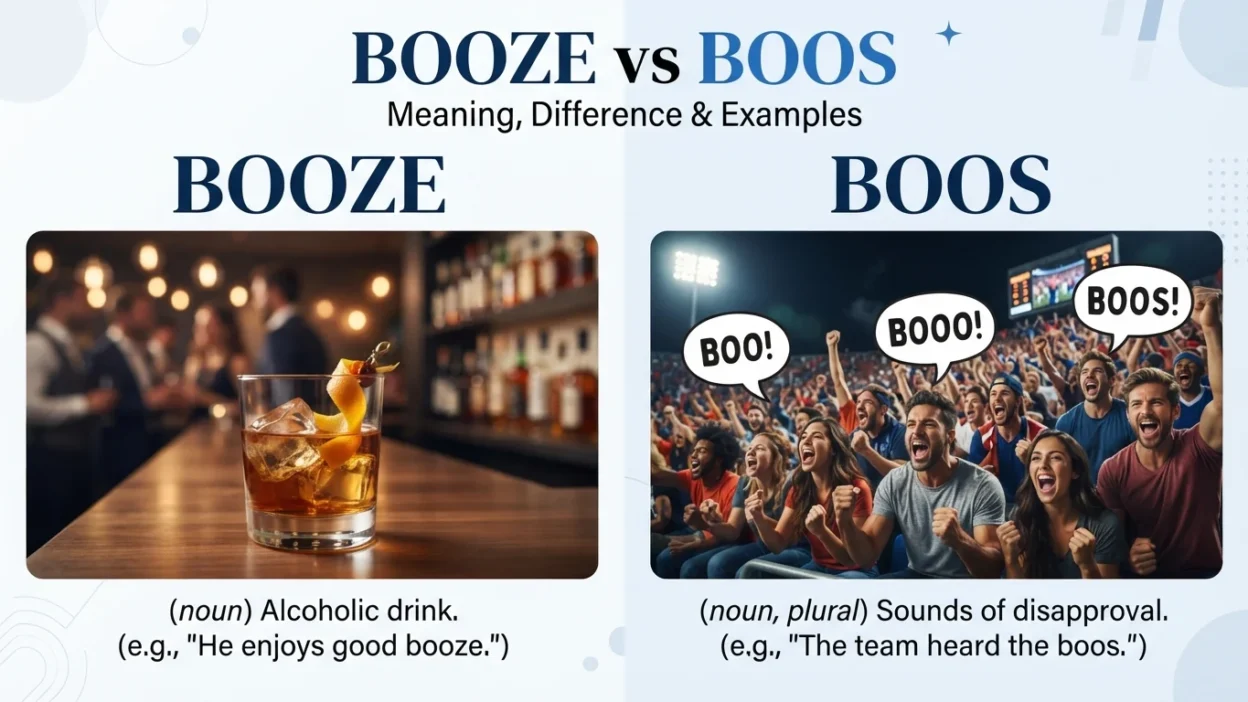
Booze means alcoholic drinks or alcohol, while boos refers to expressions of disapproval, usually from an audience. For example, “He bought some booze” means alcohol, while “The player heard boos” means people expressed disapproval.
Why People Confuse It
The main reason people confuse booze and boos is their similar pronunciation.
When spoken quickly, the difference between the two can be difficult to notice. Both contain the long oo sound, but their spellings and meanings are completely different.
Here are the key differences:
- Booze = alcoholic drinks or alcohol.
- Boos = expressions of disapproval.
- Booze can be a noun or verb.
- Boos is generally a plural noun or a third person singular verb.
- Booze is associated with drinking.
- Boos is associated with criticism, rejection, or an audience reaction.
Context usually makes the intended meaning obvious.
First Word: Booze
Booze is an informal word for alcohol or alcoholic drinks.
It is commonly used in casual conversation rather than formal writing. It can refer to alcohol in general or alcoholic beverages collectively.
Booze as a noun
As a noun, booze means alcoholic drinks.
Examples:
- “They brought plenty of booze to the party.”
- “He decided to stay away from booze for a month.”
- “There was too much booze at the celebration.”
In this use, booze is generally treated as an uncountable noun. You would normally say “some booze” rather than “a booze.”
Booze as a verb
Booze can also function as a verb meaning to drink alcohol, especially heavily or regularly.
Examples:
- “They spent the evening boozing.”
- “He used to booze with his friends on weekends.”
The related forms include boozed and boozing.
Synonyms for booze
Depending on context, alternatives include:
- alcohol
- alcoholic drinks
- liquor
- drinks
- spirits
- intoxicating beverages
Because booze is informal, words such as alcohol or alcoholic beverages are usually better in formal or academic writing.
Second Word: Boos
Boos refers to expressions of disapproval, usually made by people making a “boo” sound.
For example:
“The referee was met with boos from the crowd.”
Here, boos means that people in the audience expressed their dissatisfaction.
Boos as a noun
Boos is the plural of boo when “boo” means an expression of disapproval.
Examples:
- “The singer received loud boos from the audience.”
- “Boos echoed around the stadium.”
- “The politician faced boos during the speech.”
Boos as a verb
Boos can also be the third person singular form of the verb boo.
Examples:
- “The crowd boos the visiting team.”
- “The audience boos whenever the referee makes a bad call.”
So, depending on the sentence, boos can mean either multiple expressions of disapproval or the action performed by a singular subject.
Comparison Table
| Word | Meaning | Part of Speech | Example |
| booze | Alcohol or alcoholic drinks | Noun | “They bought some booze.” |
| booze | Drink alcohol, often heavily | Verb | “He used to booze every weekend.” |
| boos | Expressions of disapproval | Plural noun | “The player heard boos.” |
| boos | Expresses disapproval | Verb | “The crowd boos the referee.” |
The simplest distinction is: booze is about alcohol; boos are about disapproval.
When to Use Each
Use booze when you’re talking about alcohol.
Use “booze” for:
- alcoholic drinks
- drinking alcohol
- casual conversations about alcohol
- informal descriptions of drinking
Example:
“She doesn’t keep any booze in the house.”
Use boos when you’re talking about negative audience reactions.
Use “boos” for:
- expressions of disapproval
- audience reactions
- sports crowds
- public criticism
- people making a “boo” sound
Example:
“The referee was greeted with boos.”
A simple test
Ask yourself:
Is the sentence about alcohol?
→ Use booze.
Is the sentence about people expressing disapproval?
→ Use boos.
Examples of Booze vs Boos
Here are more examples to make the difference clear.
- “They bought some booze for the party.”
Here, booze means alcoholic drinks. - “The actor received boos after his speech.”
Here, boos means expressions of disapproval. - “He decided to quit booze.”
Here, booze refers to alcohol. - “The team was met with boos when it entered the field.”
Here, boos describes the crowd’s reaction. - “There was plenty of booze at the wedding.”
Booze means alcohol. - “The politician heard boos from the audience.”
Boos means sounds of disapproval. - “He spent years boozing with his friends.”
Here, boozing is the verb form related to booze. - “The crowd boos the referee after the controversial decision.”
Here, boos is a verb. - “Please don’t bring any booze to the event.”
Booze refers to alcoholic beverages. - “Loud boos filled the stadium.”
Boos refers to expressions of dissatisfaction. - “She avoids booze during the workweek.”
Booze means alcohol. - “The fans boos the player” is incorrect.
The correct sentence is “The fans boo the player.”
This last example highlights an important grammatical point: boos is used with a singular third person subject, such as “the crowd,” not normally with a plural subject such as “the fans.”
Common Mistakes
1. Using “boos” when you mean alcohol
❌ “They brought some boos to the party.”
✅ “They brought some booze to the party.”
The first sentence suggests they brought expressions of disapproval, which doesn’t make sense in this context.
2. Using “booze” for audience reactions
❌ “The singer was met with booze from the audience.”
✅ “The singer was met with boos from the audience.”
The audience makes boos, not booze.
3. Confusing “boos” with “boo”
Boo is singular, while boos can be plural.
- “Someone shouted a boo.”
- “The player heard several boos.”
4. Misusing “boos” as a verb
With a plural subject, use boo, not boos.
❌ “The fans boos the referee.”
✅ “The fans boo the referee.”
But with a singular subject:
✅ “The crowd boos the referee.”
5. Assuming similar pronunciation means similar meaning
English has many words that sound alike but have unrelated meanings. Always use the context and spelling to determine which word belongs in your sentence.
Memory Trick
Here’s an easy way to remember booze vs boos:
Booze has “ze” → think of a drink.
You can remember:
Booze = booze you drink.
And:
Boos = boos you hear from a crowd.
Imagine a party: booze is on the table.
Imagine a stadium: boos are coming from the crowd.
That simple contrast can help you remember the spelling instantly.
American vs British English
The words booze and boos are understood in both American and British English.
Booze is an informal term for alcohol in both varieties of English. British speakers may use it particularly naturally in casual conversation, while American speakers also commonly understand and use the term.
Boos has the same basic meaning in both varieties: expressions of disapproval.
For example:
- American English: “The player was greeted by boos.”
- British English: “The player was greeted by boos.”
The major difference is therefore not American vs British spelling or meaning. Both forms use booze for alcohol and boos for expressions of disapproval.
Similar Words
Several words are related to booze and boos, but they shouldn’t be confused.
Alcohol
Alcohol is the standard, neutral term for alcoholic substances or drinks.
“The restaurant serves alcohol.”
Liquor
Liquor commonly refers to distilled alcoholic beverages, especially in American English.
“The store sells liquor.”
Boo
Boo can be an expression of disapproval.
“The audience gave the performer a loud boo.”
It can also be used as a verb:
“The crowd began to boo.”
Applause
Applause is essentially the opposite type of audience response to boos.
“The speaker received enthusiastic applause.”
Cheers
Cheers can refer to enthusiastic sounds from a crowd, while boos indicate disapproval.
“The team received cheers from its supporters.”
Understanding these related terms makes the difference between booze and boos easier to recognize.
FAQs About Booze vs Boos
Is “booze” a proper English word?
Yes. Booze is a standard English word, although it is informal. It means alcohol or alcoholic drinks and can also be used as a verb meaning to drink alcohol.
What does “boos” mean?
Boos can mean expressions of disapproval, usually from an audience or crowd. It can also be the third person singular form of the verb boo.
Are “booze” and “boos” pronounced the same?
They can sound very similar, especially in rapid speech. However, the final sounds differ: booze ends with a /z/ sound, while boos ends with an /s/ sound.
Is “booze” singular or plural?
When booze means alcohol, it is generally an uncountable noun. You can say “some booze” or “a lot of booze,” rather than normally saying “a booze.”
Is “boos” the plural of “boo”?
Yes. When boo means an expression of disapproval, boos is its plural form.
Can “booze” be a verb?
Yes. To booze means to drink alcohol, often suggesting heavy or excessive drinking. For example, “They spent the night boozing.”
What is the easiest way to remember “booze vs boos”?
Remember: booze = alcohol, while boos = sounds of disapproval. If you’re talking about drinking, choose booze. If you’re talking about a crowd’s negative reaction, choose boos.
Final Verdict
The difference between booze vs boos is simple once you connect each spelling with its meaning. Booze refers to alcohol or drinking alcohol, while boos refers to expressions of disapproval or the act of expressing disapproval.
Although the words can sound similar, their contexts are completely different. Use booze for informal references to alcohol and boos when describing a crowd or audience reacting negatively. When in doubt, ask yourself whether you’re talking about drinking or disapproval.
Remember This
Booze = alcohol.
Boos = expressions of disapproval.
Think party → booze and stadium → boos. Once you make that mental connection, you’ll rarely confuse these two words again.
Conclusion
Booze vs boos is a classic example of how similar sounding English words can have completely different meanings. Booze is an informal word for alcohol or alcoholic drinks, while boos describes sounds or expressions of disapproval. Grammar also matters: boos can function as a plural noun or a third person singular verb.
The best way to remember the distinction is to focus on context. If the sentence involves alcohol, drinking, or alcoholic beverages, booze is probably the word you need. If it involves a crowd showing dissatisfaction, use boos. A little attention to spelling can make your English more precise and natural.

Quinn Mitchell is celebrated for historical fiction that combines authentic settings, unforgettable characters, and compelling narratives. His thoughtful writing brings history alive while inspiring curiosity and deeper understanding among readers.