Have you ever wondered whether to use phenomenon or phenomena in a sentence? These two words look almost identical and share the same basic meaning, but they have one important grammatical difference. Phenomenon is the singular form, while phenomena is the plural form. Both words describe events, situations, facts, or experiences that can be observed, studied, or noticed.
Understanding the difference between phenomenon vs. phenomena can help you write more clearly and avoid common grammar mistakes. Whether you are a student, an English learner, or someone improving everyday writing skills, knowing when to use each word is essential. In this guide, you will learn their definitions, pronunciation, grammatical forms, differences, and correct usage through simple explanations, practical examples, and helpful memory tricks.
Quick Answer: Phenomenon vs. Phenomena
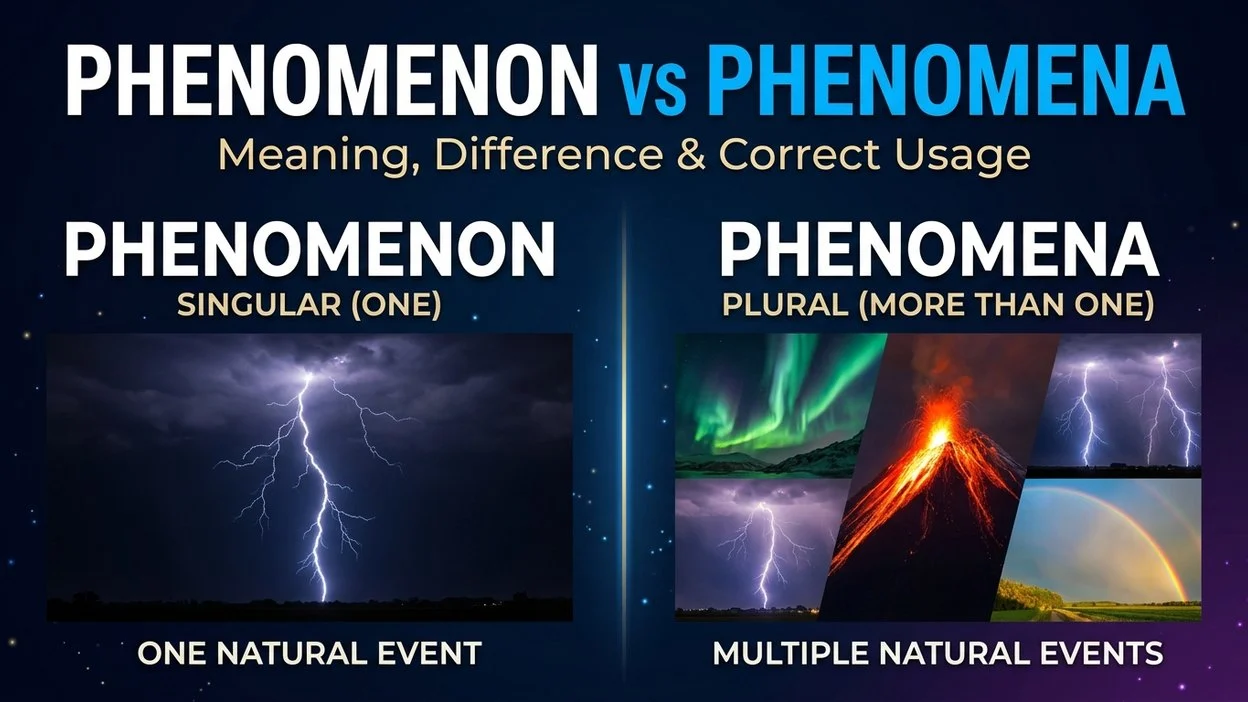
Phenomenon refers to one observable event, fact, or occurrence. Phenomena refers to two or more observable events or occurrences. For example, a rainbow is a natural phenomenon, while rainbows, earthquakes, and volcanic eruptions are natural phenomena. The main difference is singular versus plural.
What Is the Difference Between Phenomenon and Phenomena?
The main difference between phenomenon and phenomena is number. One word describes a single occurrence, while the other describes multiple occurrences.
- Phenomenon: Singular noun used for one event, situation, or observable fact.
- Phenomena: Plural noun used for two or more events, situations, or observable facts.
Both words are commonly used in science, education, psychology, sociology, and everyday conversations.
For example:
- The Northern Lights are a fascinating natural phenomenon.
- Scientists study different atmospheric phenomena.
In the first sentence, the word phenomenon refers to one type of natural occurrence. In the second, phenomena refers to multiple types of occurrences.
What Does Phenomenon Mean?
Phenomenon is a singular noun that describes something observable, noticeable, or experienced. It can refer to a natural event, an unusual situation, a social trend, or an interesting occurrence.
The word is commonly used when discussing something that attracts attention or requires explanation.
Definition of Phenomenon
According to its general English meaning, a phenomenon is:
- An observable event or occurrence.
- A fact or situation that can be noticed or experienced.
- Something unusual, interesting, or remarkable.
- An event that may require scientific or logical explanation.
Pronunciation of Phenomenon
Phenomenon is pronounced:
fi-NOM-uh-non
It has four syllables, with the main stress on the second syllable.
Phenomenon as a Part of Speech
Phenomenon is a noun. It can function as the subject or object of a sentence.
Examples:
- A solar eclipse is a rare astronomical phenomenon.
- Climate change is a complex environmental phenomenon.
- The sudden increase in online shopping is an interesting phenomenon.
- Scientists investigated this unusual phenomenon.
- The northern lights are a beautiful natural phenomenon.
When to Use Phenomenon
Use phenomenon when you are talking about one event, occurrence, or observable situation.
For example:
- One scientific discovery can be described as a phenomenon.
- One unusual weather event is a phenomenon.
- One popular social trend can be called a phenomenon.
Example sentence: The sudden appearance of the rainbow was a beautiful phenomenon.
Here, phenomenon is correct because the sentence refers to one observable occurrence.
What Does Phenomena Mean?
Phenomena is the plural form of phenomenon. It describes two or more observable events, occurrences, facts, or situations.
It is often used in scientific discussions, academic writing, and everyday explanations involving multiple events.
Definition of Phenomena
Phenomena refers to:
- Multiple observable events or occurrences.
- Different natural or scientific processes.
- Various situations that can be noticed or experienced.
- Multiple unusual or interesting developments.
Pronunciation of Phenomena
Phenomena is pronounced:
fi-NOM-uh-nuh
It has four syllables, with the main stress on the second syllable.
Phenomena as a Part of Speech
Phenomena is a plural noun. It is used when referring to more than one event or occurrence.
Examples:
- Scientists study natural phenomena to understand the world.
- Several unusual phenomena occurred during the experiment.
- Weather phenomena can affect daily life.
- Social media has created new cultural phenomena.
- Researchers examined different psychological phenomena.
When to Use Phenomena
Use phenomena when discussing multiple events, situations, or observable facts.
For example:
- Different types of storms are weather phenomena.
- Earthquakes, volcanoes, and tsunamis are natural phenomena.
- Dreams, emotions, and memory are psychological phenomena.
Example sentence: Scientists are studying several mysterious phenomena in outer space.
Here, phenomena is correct because the sentence refers to multiple occurrences.
Phenomenon vs. Phenomena: Comparison Table
The following table highlights the important differences between these two words.
| Feature | Phenomenon | Phenomena |
| Meaning | One observable event | Multiple observable events |
| Grammatical number | Singular | Plural |
| Part of speech | Noun | Noun |
| Pronunciation | fi-NOM-uh-non | fi-NOM-uh-nuh |
| Verb agreement | Is, was, has | Are, were, have |
| Article usage | A phenomenon | Phenomena |
| Number | One | Two or more |
| Example | A natural phenomenon | Natural phenomena |
The easiest way to remember the difference is that phenomenon means one, while phenomena means more than one.
Why Do People Confuse Phenomenon and Phenomena?
Many English speakers confuse these words because their spelling and meanings are very similar. Both describe observable events, and their pronunciation is almost identical.
However, there are several reasons behind this common mistake.
1. Similar Spelling
Both words contain almost the same letters. The main difference appears at the end:
- Phenomenon ends in -on.
- Phenomena ends in -a.
This small spelling change can make it difficult to remember which word is singular or plural.
2. Unusual Plural Formation
Most English nouns form their plurals by adding -s or -es. For example:
- Book → Books
- Class → Classes
- Car → Cars
However, phenomenon follows a different plural pattern because it comes from Greek.
Its plural form changes from phenomenon to phenomena.
3. Similar Pronunciation
Both words have similar sounds, which can make their differences difficult to recognize during conversations.
Writers sometimes remember the meaning but forget the correct grammatical form.
4. Limited Everyday Usage
Phenomenon and phenomena are more common in academic, scientific, and descriptive writing than in casual conversations. Some people rarely use them, making it harder to remember their correct forms.
Grammatical Forms of Phenomenon and Phenomena
Understanding the grammatical forms of these words helps you use them correctly in sentences.
Singular and Plural Forms
| Singular | Plural |
| Phenomenon | Phenomena |
Unlike regular English nouns, the plural does not use an additional -s.
Articles and Determiners
Use a or the with the singular noun when appropriate.
Correct:
- A strange phenomenon occurred yesterday.
- The phenomenon surprised everyone.
With the plural noun, do not use a or an.
Correct:
- Several phenomena were observed.
- These phenomena are difficult to explain.
Verb Agreement
The singular form takes singular verbs, while the plural form takes plural verbs.
With phenomenon:
- The phenomenon is unusual.
- This phenomenon was unexpected.
- The phenomenon has attracted attention.
With phenomena:
- The phenomena are unusual.
- These phenomena were unexpected.
- The phenomena have attracted attention.
Phenomenon vs. Phenomena: Practical Examples
Here are additional examples showing how to use both words correctly in different situations.
Examples Using Phenomenon
- A solar eclipse is an amazing natural phenomenon.
- The popularity of electric vehicles is a growing phenomenon.
- Scientists discovered an unusual phenomenon in the laboratory.
- The spread of online education has become a global phenomenon.
- The sudden temperature change was an unexpected phenomenon.
Examples Using Phenomena
- Earthquakes and volcanic eruptions are natural phenomena.
- Scientists investigate various physical phenomena.
- Different psychological phenomena influence human behavior.
- Researchers observed several unusual phenomena in space.
- Weather phenomena can sometimes create dangerous conditions.
More Examples in Everyday Contexts
- Phenomenon: The sudden popularity of the new smartphone became a worldwide phenomenon.
- Phenomena: Different cultural phenomena influence how people communicate.
- Phenomenon: A rainbow is a common atmospheric phenomenon.
- Phenomena: Lightning, thunder, and rain are familiar weather phenomena.
- Phenomenon: The rapid growth of artificial intelligence is a modern technological phenomenon.
- Phenomena: Scientists continue to explore mysterious phenomena throughout the universe.
- Phenomenon: The audience considered her incredible performance a remarkable phenomenon.
- Phenomena: Various biological phenomena help explain how living organisms function.
Common Mistakes When Using Phenomenon and Phenomena
Even experienced English writers sometimes use these words incorrectly. Here are common mistakes and their corrections.
Mistake 1: Using Phenomena for One Event
Incorrect: A rainbow is a beautiful natural phenomena.
Correct: A rainbow is a beautiful natural phenomenon.
Explanation: A rainbow is one observable event, so the singular form is required.
Mistake 2: Using Phenomenon for Multiple Events
Incorrect: Earthquakes and hurricanes are natural phenomenon.
Correct: Earthquakes and hurricanes are natural phenomena.
Explanation: The sentence refers to multiple events, so the plural form is necessary.
Mistake 3: Using a With Phenomena
Incorrect: A phenomena occurred during the experiment.
Correct: A phenomenon occurred during the experiment.
Explanation: The article a must be followed by a singular countable noun.
Mistake 4: Using Singular Verbs With Phenomena
Incorrect: These phenomena is difficult to understand.
Correct: These phenomena are difficult to understand.
Explanation: Phenomena is plural, so it requires a plural verb.
Mistake 5: Adding an Extra S to Phenomena
Incorrect: The phenomenas are fascinating.
Correct: The phenomena are fascinating.
Explanation: Phenomena is already the plural form. It does not need another -s.
An Easy Memory Trick to Remember the Difference
If you frequently confuse phenomenon and phenomena, use this simple memory trick:
Phenomenon = One
Phenomena = Many
Remember these two points:
- Phenomenon ends in -on and refers to one occurrence.
- Phenomena ends in -a and refers to multiple occurrences.
You can also remember this example:
- One phenomenon is interesting.
- Many phenomena are interesting.
Another helpful trick is to connect phenomenon with the phrase a phenomenon and phenomena with many phenomena.
Practicing these expressions will make the difference easier to remember.
American English vs. British English: Is There a Difference?
There is no meaningful difference between American and British English when it comes to the spelling, meaning, or grammatical usage of phenomenon and phenomena.
Both varieties follow the same singular and plural pattern:
- American English: Phenomenon → Phenomena
- British English: Phenomenon → Phenomena
The pronunciation may vary slightly depending on regional accents, but the grammatical rules remain the same.
Therefore, you can use both words confidently in American and British English.
Similar and Related Words
Several English words have meanings related to phenomenon and phenomena. Learning these words can help expand your vocabulary.
1. Occurrence
An occurrence is an event or something that happens.
Example: Snowfall is a common occurrence in some northern states.
2. Event
An event is something that happens, especially something important or noticeable.
Example: The solar eclipse was a major scientific event.
3. Incident
An incident is an event, often one that is unusual or unexpected.
Example: The unusual incident attracted public attention.
4. Situation
A situation refers to the circumstances surrounding a particular event or condition.
Example: The situation became difficult to understand.
5. Spectacle
A spectacle is something visually impressive or unusual.
Example: The colorful fireworks created an amazing spectacle.
6. Phenomenal
Phenomenal is an adjective meaning extraordinary, remarkable, or exceptionally good.
Example: The team delivered a phenomenal performance.
Remember that phenomenal is related to phenomenon, but it is not its plural form.
FAQs:
1. Is phenomenon singular or plural?
Phenomenon is singular. It refers to one observable event, fact, or occurrence. For example, a solar eclipse is a natural phenomenon. When you discuss more than one event, you should use phenomena instead.
2. Is phenomena singular or plural?
Phenomena is plural. It is used when discussing two or more observable events or occurrences. For example, earthquakes, hurricanes, and tornadoes are natural phenomena. The singular form is phenomenon.
3. What is the plural of phenomenon?
The plural of phenomenon is phenomena. It is an irregular plural form derived from Greek. Unlike regular English nouns, you do not add -s to make it plural.
4. Can I use phenomena in a singular sentence?
No. Phenomena is grammatically plural and should not be used to describe only one event. Use phenomenon for a single occurrence. For example, say “This phenomenon is unusual,” not “This phenomena is unusual.”
5. Why is the plural of phenomenon phenomena?
The word phenomenon comes from Greek, where certain nouns use different endings for singular and plural forms. English has retained this traditional plural pattern. That is why phenomenon becomes phenomena rather than phenomenons in standard usage.
6. Is phenomenon a countable or uncountable noun?
Phenomenon is a countable noun. You can refer to one phenomenon or several phenomena. For example, one scientific phenomenon can be studied individually, while multiple phenomena can be examined together.
7. What is the difference between phenomenon and phenomena in science?
In science, phenomenon refers to one observable event or process, while phenomena refers to multiple observable events or processes. For example, gravity can be discussed as a physical phenomenon, while different physical processes are described as physical phenomena.
8. Is phenomenons ever correct?
Phenomenons is not the standard plural form of phenomenon in ordinary English. The correct plural is phenomena. Use phenomena in academic, professional, and everyday writing when referring to multiple occurrences.
Remember This: Phenomenon vs. Phenomena
Keep these simple rules in mind:
- Phenomenon = Singular: One event or occurrence.
- Phenomena = Plural: Two or more events or occurrences.
- Use a phenomenon, not a phenomena.
- Use these phenomena are, not these phenomena is.
- Never add an extra -s to phenomena.
The most important rule is simple: phenomenon means one, and phenomena means many.
Conclusion:
Understanding phenomenon vs. phenomena is easy once you remember their grammatical difference. Phenomenon is the singular noun used for one observable event, fact, or occurrence, while phenomena is its plural form used for multiple events or occurrences. Although their meanings are closely related, choosing the correct form depends on whether you are discussing one thing or several things.
To use these words confidently, pay attention to singular and plural subjects, articles, and verb agreement. Remember that one natural event is a phenomenon, while several natural events are phenomena. With regular practice and the examples in this guide, you can avoid common mistakes and use both words accurately in everyday conversations, academic assignments, and professional writing.

Quinn Mitchell is celebrated for historical fiction that combines authentic settings, unforgettable characters, and compelling narratives. His thoughtful writing brings history alive while inspiring curiosity and deeper understanding among readers.