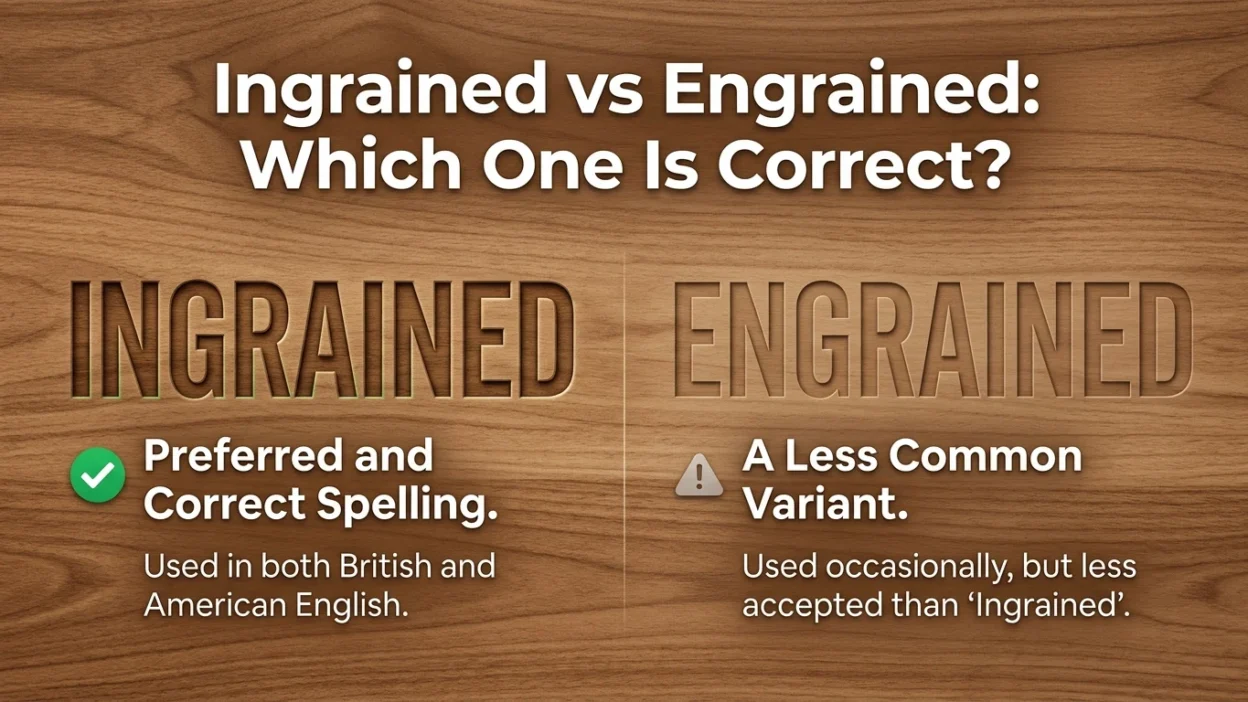
If you have ever hesitated between “ingrained” and “engrained,” you are not alone. These two words look almost identical and are often used in the same contexts, especially when describing habits, beliefs, behaviors, or ideas that have become deeply established. That similarity makes it easy to wonder whether one is a spelling mistake or whether both forms are acceptable. The good news is that the answer is fairly straightforward: ingrained is the standard and overwhelmingly preferred spelling in modern English.
“Engrained” does appear in dictionaries and real world usage, but it is much less common and is generally treated as a variant of “ingrained.” Understanding the difference can help you choose the most natural word in academic writing, professional communication, everyday conversation, and formal English. In this guide, we will examine the meanings, usage, examples, common mistakes, British and American English preferences, and an easy memory trick so you never have to second guess ingrained vs engrained again.
Quick Answer
Ingrained is the standard spelling and the best choice in most situations. It means something deeply fixed or firmly established, such as a habit, belief, attitude, or behavior. Engrained is an accepted but uncommon variant. For clear, conventional English, use ingrained.
Why People Confuse It
The confusion comes from the fact that both ingrained and engrained appear in English writing.
They also sound very similar when spoken. Both can be used to describe something that has become deeply fixed over time.
For example:
- an ingrained habit
- an ingrained belief
- an ingrained attitude
- an ingrained behavior
The spelling engrained can seem logical because English has the verb engrain, which means to establish something deeply. However, ingrain is the more familiar and standard form, and ingrained is by far the more common adjective.
So, while you may encounter engrained, it is usually safer and more natural to write ingrained.
First Word: Ingrained
Ingrained is the standard spelling and the form you should normally choose.
It means deeply established, firmly fixed, or difficult to change.
It is especially common when talking about things that develop through repetition, experience, culture, or long term influence.
Common collocations with “ingrained”
- ingrained habit
- ingrained belief
- ingrained behavior
- ingrained attitude
- ingrained prejudice
- ingrained tradition
- ingrained tendency
- ingrained assumption
- deeply ingrained values
- culturally ingrained practices
Examples
His morning exercise routine is deeply ingrained.
She has an ingrained fear of public speaking.
The word does not necessarily describe something negative. An ingrained habit can be helpful or harmful depending on the situation.
For example, being polite can become an ingrained habit, while procrastination can also become ingrained behavior.
Second Word: Engrained
Engrained is a less common variant of ingrained.
It carries essentially the same meaning: something that is deeply established, fixed, or embedded.
You may find engrained in dictionaries and published writing, but it is considerably less common than ingrained.
For most readers, ingrained will look more familiar and immediately recognizable.
Should you use “engrained”?
Generally, no—not when you have the choice.
There is nothing inherently confusing about engrained, but ingrained is the established conventional form in modern standard English.
If you are writing:
- an academic paper
- a business report
- a résumé
- a formal email
- an article
- an examination answer
- professional content
Ingrained is the better choice.
Comparison Table
| Feature | Ingrained | Engrained |
| Meaning | Deeply established or fixed | Deeply established or fixed |
| Standard usage | Yes | Less common variant |
| Frequency | Very common | Relatively uncommon |
| Formal writing | Preferred | Usually avoided |
| Common collocations | Ingrained habit, belief, attitude | Same meaning, but less frequent |
| Best choice | Yes | Usually no |
| Example | An ingrained habit | An engrained habit |
When to Use Each
Use “ingrained” when:
You want the standard, widely recognized form.
Example:
Respect for others was an ingrained part of her upbringing.
Use “engrained” when:
You are reproducing a quotation, discussing historical usage, or deliberately using the less common variant.
For ordinary modern writing, there is rarely a practical reason to choose engrained over ingrained.
A useful rule
If you are wondering which spelling your reader expects, choose:
ingrained
It is the safer and more conventional option.
Examples
Here are more examples showing how ingrained works naturally in sentences:
- Good manners were ingrained in him from childhood.
- The company has an ingrained culture of innovation.
- Her fear of failure had become deeply ingrained.
- Some social attitudes are so ingrained that people rarely question them.
- Checking his phone every few minutes became an ingrained habit.
- The belief was deeply ingrained in the local community.
- Years of training had ingrained discipline into the athletes.
- She tried to change her ingrained tendency to worry.
- Trust is an ingrained part of their relationship.
- The tradition is deeply ingrained in the region’s culture.
- His ingrained assumptions made it difficult to consider another perspective.
- By adulthood, many childhood habits are already deeply ingrained.
- The teacher wanted students to develop an ingrained habit of reading every day.
- Their ingrained routines made the transition surprisingly difficult.
Notice that ingrained often appears with words such as deeply, firmly, culturally, socially, and strongly.
Common Mistakes
1. Assuming “engrained” is always incorrect
This is too simplistic.
Engrained is found in English usage and dictionaries as a variant. However, it is much less common than ingrained.
So the better advice is not “engrained is impossible,” but rather:
Use ingrained as your default spelling.
2. Thinking “ingrained” only describes bad habits
It does not.
You can have:
- ingrained discipline
- ingrained kindness
- ingrained respect
- ingrained loyalty
- ingrained confidence
The meaning simply suggests that something has become firmly established.
3. Confusing it with “engraved”
The words may look related, but ingrained and engraved are not interchangeable.
Engraved usually means words, images, or designs physically carved into a surface.
Her name was engraved on the trophy.
Ingrained usually describes something deeply established in a person’s mind, behavior, culture, or system.
The habit was ingrained in his daily routine.
4. Writing “ingrainned”
The correct spelling is:
ingrained
Not:
ingrainned
The base verb is ingrain, so its past form is ingrained.
Memory Trick
Here is a simple way to remember the preferred spelling:
Think “IN + GRAIN.”
Imagine something being pressed into the grain of wood until it becomes difficult to remove.
That gives you:
IN + GRAIN → INGRAIN → INGRAINED
So when you mean “deeply fixed” or “firmly established,” think:
It is IN the grain → ingrained.
This memory trick also helps distinguish the word from engraved, which refers more directly to carving or marking a surface.
American vs British English
Both American and British English use ingrained as the normal form.
The spelling engrained can be found in both varieties as a less common variant, so this is not a case where American English strongly prefers one spelling while British English prefers another.
For international English, academic writing, business communication, and general professional use, ingrained is the safest choice.
In other words:
- American English: ingrained ✓
- British English: ingrained ✓
- International standard usage: ingrained ✓
- Engrained: possible variant, but uncommon
Similar Words
Several words are related to ingrained, but they are not always exact synonyms.
Embedded
Means firmly placed or established within something.
The idea was deeply embedded in the culture.
Deep rooted
Describes something that has existed for a long time and is difficult to change.
The community has deep rooted traditions.
Entrenched
Usually suggests that something is firmly established and resistant to change.
The organization has an entrenched bureaucracy.
Established
Simply means accepted, recognized, or firmly set up.
It is an established practice.
Habitual
Describes something regularly done or customary.
His habitual lateness frustrated his colleagues.
Instilled
Means deliberately introduced into someone’s mind or character, usually through teaching or repeated influence.
Her parents instilled strong values in her.
These words overlap with ingrained, but each has its own shade of meaning.
FAQs
Is “ingrained” or “engrained” correct?
Ingrained is the standard and much more common spelling. Engrained exists as a less common variant, but ingrained is generally the preferred choice.
Is “engrained” a spelling mistake?
Not necessarily. Engrained is recognized as a variant in English, but it is uncommon. In most modern writing, ingrained is the more conventional spelling.
What does “ingrained” mean?
Ingrained means deeply established, firmly fixed, or difficult to change. It often describes habits, beliefs, attitudes, behaviors, traditions, or values.
Is “deeply ingrained” correct?
Yes. Deeply ingrained is a very common and natural phrase.
The belief was deeply ingrained in the community.
Can “ingrained” describe a person?
Usually, ingrained describes something associated with a person rather than the person directly. For example, you can have an ingrained habit, belief, attitude, or tendency.
Is “ingrained” more common in American or British English?
It is standard in both. Neither variety generally requires engrained instead.
What is the difference between ingrained and engraved?
Ingrained means deeply established or fixed, while engraved usually means physically carved or marked onto a surface.
Final Verdict
When choosing between ingrained vs engrained, the simplest answer is to use ingrained.
It is the standard, familiar, and overwhelmingly preferred spelling for something that is deeply established or firmly fixed. Whether you are describing an ingrained habit, belief, attitude, tradition, or behavior, this is the form most readers will expect.
Engrained is not simply meaningless or impossible; it exists as a variant. However, because it is much less common, choosing it can make your writing look unusual or potentially raise a spelling question for your audience.
Remember This
INGRAINED = the standard choice.
Think:
IN + GRAIN → INGRAINED
If you mean deeply fixed, firmly established, or difficult to change, use ingrained.
Conclusion
The ingrained vs engrained confusion is understandable because both spellings exist and both carry essentially the same meaning. However, modern standard English strongly favors ingrained, making it the best option for everyday, academic, professional, and formal writing. You will commonly see it paired with words such as habit, belief, attitude, behavior, tradition, and values.
You do not need to worry about completely misunderstanding engrained if you encounter it. It is a recognized variant, but it is much less common. For clear and conventional English, remember the simple rule: when in doubt, choose ingrained.

Quinn Mitchell is celebrated for historical fiction that combines authentic settings, unforgettable characters, and compelling narratives. His thoughtful writing brings history alive while inspiring curiosity and deeper understanding among readers.