When comparing fair vs good, the difference can seem small because both words can describe something positively. However, they usually communicate different levels of quality, ability, treatment, or acceptability. Choosing the right word depends heavily on context and what you want to express.
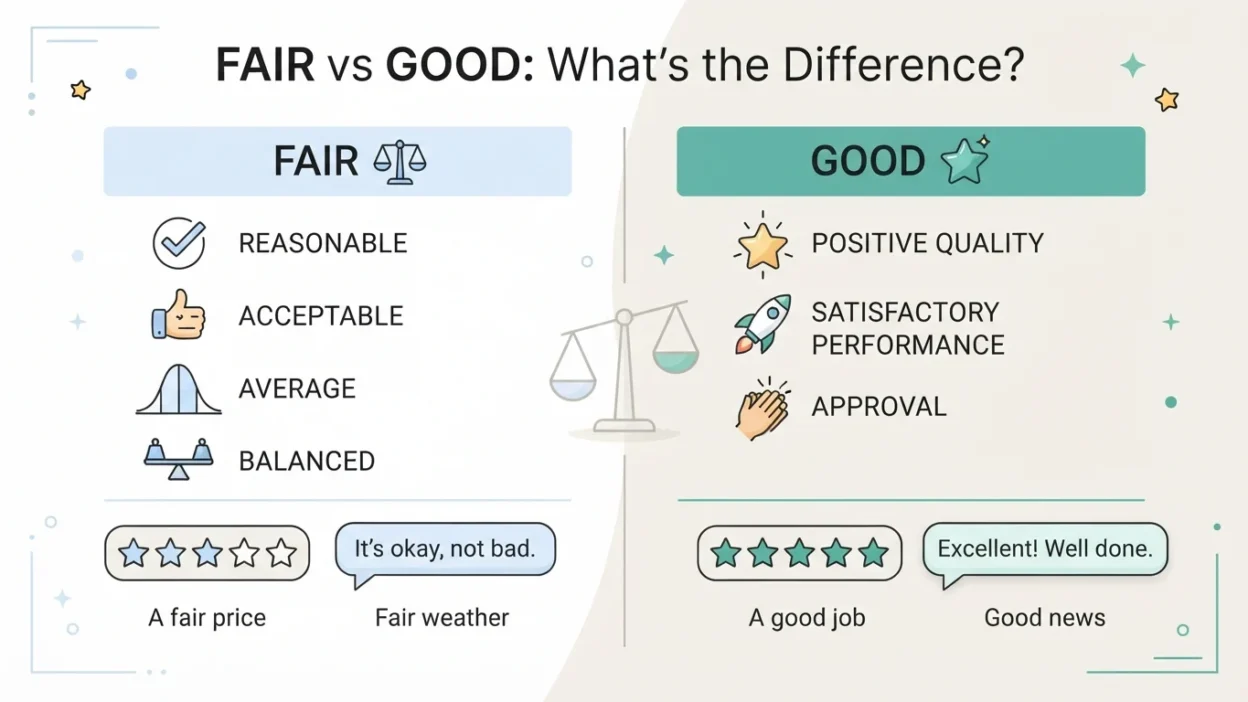
Fair often means reasonable, acceptable, or average, while good generally means satisfactory, positive, or above average. For example, if someone says, “The movie was fair,” they may mean it was acceptable but not impressive. If they say, “The movie was good,” they are giving it a clearly positive evaluation. Understanding this distinction can help you sound more precise in everyday English, academic writing, workplace communication, and casual conversation.
Quick Answer
Fair usually means reasonable, acceptable, or average, while good generally means satisfactory or positive in quality. Use fair when something is adequate but not particularly impressive, and good when you want to express stronger approval or quality.
Why People Confuse It
People often confuse fair and good because both can be used to evaluate something.
For example:
- “She is a fair student.”
- “She is a good student.”
Both sentences are grammatically correct, but they do not necessarily give the same impression.
Fair can suggest that something is adequate, average, or acceptable. Good normally gives a more positive evaluation.
There is another source of confusion: fair has several unrelated meanings. It can describe:
- Reasonable treatment: “That seems fair.”
- Average quality: “His performance was fair.”
- Light complexion: “She has fair skin.”
- An event: “We went to the county fair.”
- A clear or pleasant day: “The weather is fair.”
Because fair has such a broad range of meanings, context is essential.
First Word: Fair
Fair is an adjective with several meanings, but when it is used to evaluate quality, it commonly means acceptable, adequate, or average.
Examples
- “The restaurant received a fair review.”
- “His performance was fair.”
- “She has a fair understanding of the subject.”
In these examples, fair does not usually mean excellent. It suggests that something meets a basic standard but may have room for improvement.
Fair can also mean reasonable
This is one of the most important meanings of the word:
“That is a fair decision.”
Here, fair means just, reasonable, or impartial, not average.
Similarly:
“Everyone should receive a fair opportunity.”
In this sentence, fair means that everyone should be treated reasonably and equally.
Second Word: Good
Good is one of the most common adjectives in English. It generally describes something that has desirable qualities or meets a satisfactory standard.
Examples include:
- “She is a good teacher.”
- “That was a good idea.”
- “The food was good.”
- “He did a good job.”
Compared with fair, good usually expresses a more positive judgment.
However, the exact strength of good depends on context. It does not necessarily mean excellent or perfect.
For example:
“The movie was good, but the ending was disappointing.”
The speaker clearly likes the movie overall, but good still leaves room for stronger words such as great, excellent, or outstanding.
Fair vs Good: Comparison Table
| Feature | Fair | Good |
| Basic meaning | Reasonable, acceptable, or average | Satisfactory or positive |
| Typical evaluation | Neutral to mildly positive | Clearly positive |
| Quality level | Often average or adequate | Generally above merely acceptable |
| Can mean “just”? | Yes | No |
| Can describe treatment? | Yes | Sometimes, but not with the same meaning |
| Example | “The performance was fair.” | “The performance was good.” |
| Overall impression | It was okay | It was satisfactory or better |
Simple distinction
Fair = acceptable or average
Good = positive or satisfactory
This distinction is useful, but remember that fair has meanings that have nothing to do with quality.
When to Use Each
Use “fair” when something is acceptable or average
Use fair when you don’t want to describe something as particularly impressive.
“The food was fair.”
This suggests the food was acceptable, but probably not memorable.
Use “good” when you want to express approval
“The food was good.”
This tells the listener that you generally liked it.
Use “fair” for reasonable or impartial treatment
“The teacher gave everyone a fair chance.”
Here, replacing fair with good would change the meaning.
Use “good” for positive qualities
“She is a good teacher.”
This means she teaches effectively or has desirable qualities.
Be careful with “fairly good”
The expression fairly good is also common.
“The results were fairly good.”
Here, fairly means to a moderate degree. The results were good, but perhaps not outstanding.
Fair vs Good Examples
Here are more than ten examples showing how the two words differ.
- The movie was fair.
The movie was acceptable but not particularly impressive. - The movie was good.
The speaker generally liked the movie. - He gave a fair performance.
His performance was adequate or average. - He gave a good performance.
His performance was clearly satisfactory or impressive. - She has a fair understanding of English grammar.
Her understanding is adequate but may not be advanced. - She has a good understanding of English grammar.
Her understanding is solid. - The weather was fair.
The weather was clear or pleasant. - The weather was good.
The weather was pleasant or suitable. - That is a fair price.
The price is reasonable. - That is a good price.
The price is favorable or attractive. - The judge made a fair decision.
The decision was just and impartial. - The judge made a good decision.
The decision was wise or beneficial. - He is a fair player.
Depending on context, he may be average or play according to the rules. - He is a good player.
He has strong ability or performs well. - The book received a fair rating.
The rating suggests moderate or average quality. - The book received a good rating.
The rating indicates positive quality.
Common Mistakes
1. Assuming “fair” always means “good”
This is one of the most common mistakes.
Fair can mean acceptable, but it can also mean reasonable, impartial, light colored, or clear.
“The manager was fair.”
This usually means the manager treated people reasonably, not that the manager was merely “good.”
2. Using “good” when you mean “reasonable”
Incorrect for the intended meaning:
“The salary offer is good and equal for everyone.”
If you mean the offer is reasonable or impartial, fair may be more precise:
“The salary offer is fair.”
3. Thinking “fair” means excellent
Usually, fair is weaker than good when discussing quality.
Compare:
- fair performance → adequate or average
- good performance → satisfactory or strong
- excellent performance → exceptionally strong
4. Confusing “fair” with “fairly”
Fair is usually an adjective.
“That is a fair decision.”
Fairly is generally an adverb.
“The test was fairly easy.”
Don’t automatically substitute one for the other.
5. Assuming “good” and “fair” are interchangeable
They can overlap in some contexts, but they often create different impressions.
“The hotel was fair.”
sounds much less enthusiastic than:
“The hotel was good.”
Memory Trick
Think of a simple quality scale:
Poor → Fair → Good → Great → Excellent
This isn’t a universal ranking for every use of the words, but it is a useful way to remember their common meanings when evaluating quality.
So:
Fair = “It was okay.”
Good = “I liked it.”
And remember another important meaning:
Fair = “reasonable or just.”
For example:
“That’s a fair decision.”
American vs British English
Both fair and good are standard in American English and British English.
There is no major difference in spelling or basic meaning.
However, fair can sometimes be used differently depending on the variety of English and context. In both American and British English, it can describe something as reasonable, average, or acceptable.
For example:
“The results were fair.”
may suggest average or acceptable results.
In British English, fair can also be commonly encountered in expressions describing weather:
“It will be fair and dry.”
American English uses the word in this sense as well, although everyday speakers may choose clear, sunny, or pleasant depending on the situation.
The key point is that fair vs good is not primarily an American versus British English distinction. The difference is mainly one of meaning and context.
Similar Words
Several words are related to fair and good, but each has its own nuance.
Fair vs Average
Average directly describes something near the middle of a range.
“His score was average.”
Fair can suggest average or merely acceptable, but it has additional meanings.
Fair vs Reasonable
These words can be synonyms when discussing decisions, prices, or treatment.
“That’s a fair price.”
“That’s a reasonable price.”
Both can mean the price is acceptable.
Good vs Great
Good indicates positive quality, while great usually expresses stronger enthusiasm.
“The meal was good.”
“The meal was great.”
Good vs Excellent
Excellent is stronger than good.
“She is a good student.”
“She is an excellent student.”
The second sentence expresses a much higher level of praise.
Fair vs Poor
Fair is generally more positive than poor when evaluating quality.
Poor → Fair → Good
Again, this scale applies to quality judgments, not to every meaning of fair.
Final Verdict
When comparing fair vs good, the simplest distinction is that fair often describes something as acceptable, reasonable, or average, whereas good usually communicates a more clearly positive evaluation.
If someone says, “The service was fair,” you might understand that the service was adequate but not exceptional. If they say, “The service was good,” they are expressing stronger approval.
However, don’t assume fair is simply a weaker form of good. It can mean just, reasonable, impartial, light colored, or clear, depending on the sentence. Always consider the surrounding context before choosing the word.
FAQs
Is fair better than good?
When describing quality, good is generally more positive than fair. Fair often means acceptable or average, while good usually indicates satisfactory or positive quality.
Does fair mean average?
It can. When evaluating quality, fair may mean average, adequate, or acceptable. However, fair can also mean reasonable, impartial, or pleasant, so context matters.
Is fair a synonym for good?
Sometimes they can overlap, but they are not exact synonyms. Fair often indicates adequacy or reasonableness, while good usually expresses positive quality.
What is the difference between a fair performance and a good performance?
A fair performance is usually adequate or average. A good performance is more clearly positive and suggests that the person performed well.
Is “fair price” correct?
Yes. Fair price is a very common expression meaning a price that is reasonable or acceptable.
Can fair mean excellent?
Usually not when discussing quality. Fair generally indicates an average or acceptable level rather than an excellent one.
Which is more positive: fair or good?
In most quality related contexts, good is more positive than fair.
Remember This
Fair often means acceptable, average, reasonable, or just.
Good generally means satisfactory, positive, or of desirable quality.
Easy rule: If you mean “reasonable or okay,” consider fair. If you mean “positive or satisfactory,” choose good.
Conclusion
Understanding fair vs good is less about memorizing a strict synonym list and more about recognizing the speaker’s intended meaning. Fair can describe something as adequate or average, but it can also express fairness, reasonableness, or impartiality. Good, on the other hand, is primarily used to express positive quality or approval.
When you’re unsure, consider the level of praise you want to communicate. If something merely meets expectations, fair may be appropriate. If you genuinely want to say that something is satisfactory or positive, good is usually the better choice. And when you mean justice or reasonableness, fair is the clear choice.

Willow Evans writes uplifting fantasy stories filled with magical worlds, courageous heroes, and meaningful life lessons. Her imaginative books encourage creativity, kindness, and hope in readers of all ages.