
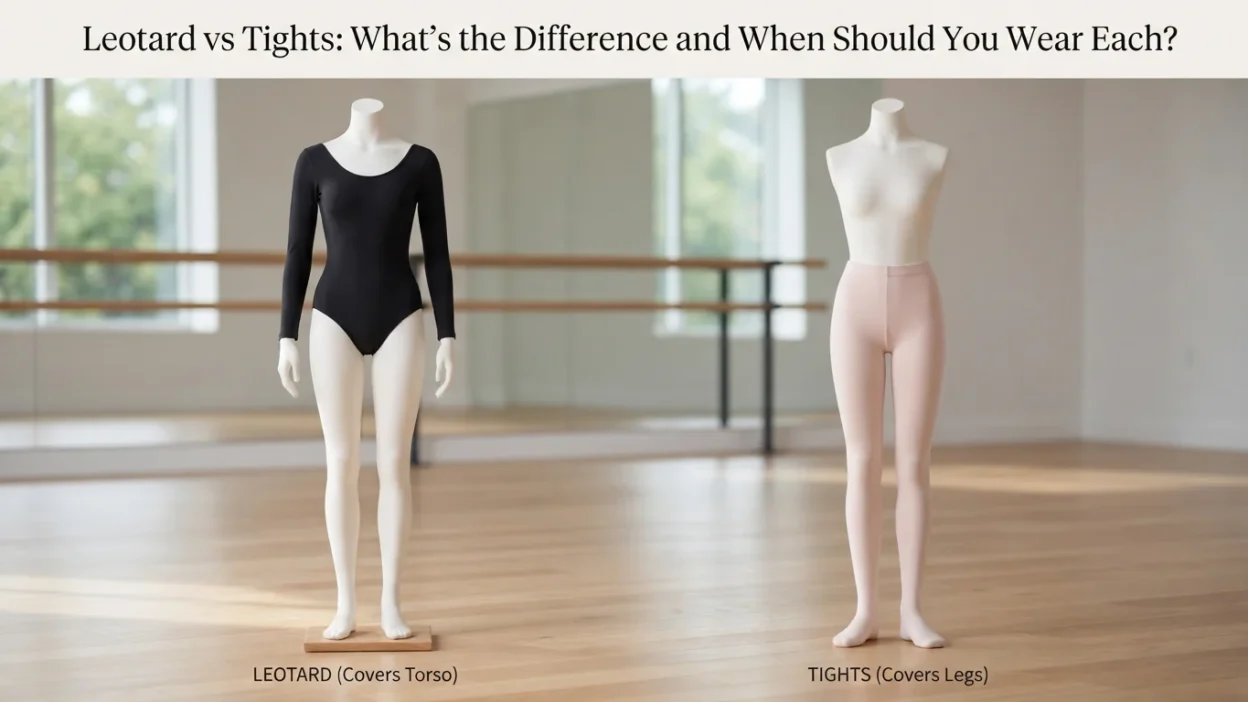
When you’re shopping for dancewear, gymnastics clothing, or stage costumes, the terms leotard and tights can easily get mixed up. Both are closely associated with ballet, dance, gymnastics, and performance, but they are not the same garment. A leotard is a one piece outfit that covers the torso and typically leaves the legs exposed, while tights are close fitting garments that cover the legs and may extend over the feet.
The confusion often comes from the fact that dancers and gymnasts frequently wear a leotard and tights together. Their similar stretchy fabrics, snug fit, and role in performance clothing can make the distinction seem less obvious. Understanding the difference is useful whether you are choosing a ballet outfit, buying gymnastics apparel, describing a costume, or simply trying to use the right English word. In this guide, we’ll explain leotard vs tights in simple terms, compare their features, give practical examples, and show you exactly when each word is appropriate.
Quick Answer
A leotard is a one piece garment covering the torso and usually leaving the legs uncovered. Tights are close fitting garments covering the legs, sometimes including the feet. Dancers and gymnasts often wear both together, but they serve different purposes.
Why People Confuse It
People confuse leotards and tights because they are often worn as part of the same outfit.
For example, a ballet dancer might wear a black leotard with pink tights. Both garments are stretchy, fitted, and designed to allow unrestricted movement.
The key difference is what part of the body each garment covers:
- A leotard covers the torso.
- Tights cover the legs.
- A leotard normally does not cover the legs below the hips.
- Tights may cover the feet, depending on the style.
- They can be worn together as dancewear or performance clothing.
So, if you remember torso = leotard and legs = tights, the distinction becomes much easier.
Leotard
A leotard is a close fitting, one piece garment that covers the body from the shoulders or upper torso down to the hips or upper thighs.
It usually has no separate legs and is designed to provide freedom of movement. Leotards are especially common in ballet, gymnastics, dance, acrobatics, and theatrical performances.
Typical features of a leotard
A leotard may have:
- Short sleeves
- Long sleeves
- No sleeves
- A high or low neckline
- A scoop or V shaped back
- Different colors and patterns
- Stretchable fabric such as spandex or Lycra
For example:
The gymnast wore a blue leotard during the competition.
Here, leotard refers to the one piece garment covering the gymnast’s torso.
The word can also refer to clothing used for exercise and other athletic activities, although its strongest associations are with dance and gymnastics.
Tights
Tights are close fitting garments that cover the legs. Depending on their design, they can extend from the waist down to the ankles or feet.
Tights are widely used in ballet, dance, theater, skating, gymnastics, and everyday fashion.
There are several types of tights, including:
- Footed tights
- Footless tights
- Stirrup tights
- Dance tights
- Ballet tights
- Opaque tights
- Sheer tights
For example:
She wore pink tights with her ballet leotard.
In this sentence, tights refers to the garment covering her legs.
Unlike a leotard, tights are not primarily a torso garment.
Comparison Table
| Feature | Leotard | Tights |
| Main purpose | Covers the torso | Covers the legs |
| Design | One piece garment | Leg covering garment |
| Leg coverage | Usually none | Yes |
| Torso coverage | Yes | Usually no |
| Common in ballet | Yes | Yes |
| Common in gymnastics | Yes | Sometimes |
| Can cover feet | No | Some styles do |
| Usually worn alone | Sometimes | Usually with another garment |
| Typical fabric | Stretch fabric | Stretch fabric |
| Example | Gymnastics leotard | Ballet tights |
When to Use Each
The easiest way to choose between leotard and tights is to think about the garment’s main area of coverage.
Use “leotard” when:
- You mean a one piece dance or gymnastics garment.
- You are talking about a garment covering the torso.
- A gymnast is wearing a competition outfit.
- A ballet dancer is wearing a one piece dance garment.
- You are describing a theatrical or acrobatic costume.
Example:
The dance school requires students to wear a black leotard.
Use “tights” when:
- You mean close fitting legwear.
- You are talking about ballet or dance legwear.
- The garment extends from the waist toward the ankles or feet.
- You are describing hosiery or performance legwear.
Example:
The ballerina changed into a fresh pair of tights before the performance.
Use both when appropriate
Sometimes the correct answer isn’t leotard or tights. It is leotard and tights.
The young dancer wore a purple leotard and matching tights.
That sentence correctly identifies two different garments.
Examples: Leotard vs Tights in Sentences
Here are more examples to make the difference clear:
- The gymnast wore a sparkling leotard during her floor routine.
- She bought a new pair of ballet tights for class.
- The instructor asked everyone to wear a black leotard.
- Her pink tights matched her ballet shoes.
- The dancer packed two leotards for the competition.
- These tights are comfortable enough for a long rehearsal.
- The gymnast’s leotard had long sleeves.
- The theater company provided tights for the performers.
- She wore a red leotard with white tights.
- The dance teacher checked that the children had clean tights.
- His gymnastics leotard was designed for maximum flexibility.
- The ballerina pulled her tights on before putting on her slippers.
Notice that the words can appear in the same sentence because they describe different parts of an outfit.
Common Mistakes
Mistake 1: Calling tights a leotard
Incorrect:
She bought a new leotard for her legs.
A leotard covers the torso, not the legs.
Better:
She bought a new pair of tights for ballet.
Mistake 2: Calling a leotard tights
Incorrect:
The gymnast wore pink tights during the competition.
If you mean the one piece garment covering her torso, leotard is the more precise word.
Better:
The gymnast wore a pink leotard during the competition.
Mistake 3: Assuming they are interchangeable
They are not interchangeable terms.
A leotard and tights may be worn together, but they describe separate pieces of clothing.
Mistake 4: Thinking all tights cover the feet
Not all tights are footed.
Footless tights stop around the ankles, while footed tights continue over the feet.
Mistake 5: Assuming every leotard is identical
Leotards come in many styles. Some have sleeves, some are sleeveless, and some have different necklines or decorative details.
Memory Trick
Use this simple trick:
Leotard = torso.
Tights = legs.
Think of a dancer getting dressed:
Leotard → body
Tights → legs
You can also remember the phrase:
Leotard on the body, tights on the legs.
Once you associate each word with its main area of coverage, you are unlikely to confuse them.
American vs British English
In both American and British English, leotard generally refers to the same type of close fitting, one piece garment.
Likewise, tights are used in both varieties of English for close fitting legwear.
However, there are some differences in how related clothing terms are used.
In American English, tights commonly refers to both fashion hosiery and athletic or dance legwear. In British English, tights is also a standard term for close fitting hosiery worn on the legs.
American English frequently uses pantyhose for thin, sheer hosiery, particularly in formal or everyday clothing contexts. British English generally uses tights for many garments that Americans might distinguish as pantyhose.
The important point is that leotard vs tights does not represent a major American British vocabulary difference. The fundamental distinction remains the same.
Similar Words
Several clothing terms are related to leotard and tights, but each has its own meaning.
Bodysuit
A bodysuit is a close fitting one piece garment covering the torso and usually fastening between the legs. It can be casual, athletic, or fashionable.
Unitard
A unitard resembles a leotard but extends down the legs, often covering the legs completely.
This makes it especially useful for performance, dance, acrobatics, and sports.
Leggings
Leggings are close fitting garments covering the legs, generally stopping at the ankles. Unlike tights, they are usually thicker and more opaque.
Pantyhose
Pantyhose are thin, usually sheer leg coverings that extend from the waist to the feet. The term is particularly common in American English.
Stockings
Stockings traditionally cover the legs but do not extend all the way to the waist. They may be held up by elastic, garters, or other means.
Dancewear
Dancewear is a broad term covering clothing worn for dance, including leotards, tights, skirts, warm up clothing, and other accessories.
Final Verdict
The difference between leotard and tights is straightforward: a leotard is primarily a one piece garment covering the torso, while tights are close fitting legwear. They may be made from similar stretchy materials and are frequently worn together, but they are separate pieces of clothing.
If you’re describing a gymnast’s one piece outfit, use leotard. If you’re describing the close fitting garment covering a dancer’s legs, use tights. When both are present, simply use both terms: a leotard and tights.
Remember This
Leotard = one piece torso garment.
Tights = close fitting legwear.
When in doubt, ask yourself: “Am I talking about the body or the legs?” Body means leotard; legs mean tights.
FAQs
1. Is a leotard the same as tights?
No. A leotard is a one piece garment that primarily covers the torso, while tights are close fitting garments that cover the legs.
2. Can you wear a leotard with tights?
Yes. Wearing a leotard with tights is common in ballet, dance, gymnastics, theater, and other performance settings.
3. Do tights cover your feet?
Some tights do. Footed tights cover the feet, while footless tights stop around the ankles.
4. What do ballet dancers wear: leotards or tights?
Ballet dancers commonly wear both. A typical ballet outfit may include a leotard, tights, and ballet slippers.
5. What is the difference between a leotard and a unitard?
A leotard usually leaves the legs uncovered, while a unitard extends down the legs and may cover the entire body from the shoulders to the ankles.
6. Are leggings the same as tights?
Not exactly. Leggings are generally thicker and more opaque, while tights can be thinner and may cover the feet.
7. Is “tights” singular or plural?
Tights is normally treated as a plural noun in English. We usually say “a pair of tights” rather than simply “a tight.”
Conclusion
Although leotards and tights often appear together in dance and gymnastics, they have distinct meanings. A leotard is a fitted one piece garment designed mainly to cover the torso, while tights are close fitting legwear that may extend over the feet. Knowing this difference makes it easier to describe dance costumes, athletic clothing, and performance outfits accurately.
The simplest rule is to focus on coverage. If you mean the one piece garment worn over the torso, choose leotard. If you mean the fitted garment worn over the legs, choose tights. Once you remember that basic distinction, choosing between these two commonly confused clothing terms becomes easy.

Quinn Mitchell is celebrated for historical fiction that combines authentic settings, unforgettable characters, and compelling narratives. His thoughtful writing brings history alive while inspiring curiosity and deeper understanding among readers.